2026-09-26 · both
Horn and Jack Reconstruct Medieval Brewing by Experiment
By  Horn and
  Jack
Jack
This post relates to another entry. Read it here.
## Can a recipe recover a lost drink?
**Horn:** Put the same recipe on the table and we have our route back: grain, water, herbs, fermentation. Follow it closely enough and we recover the drink.
**Jack:** We recover a starting proposition, not the drink itself. That is what Brian Costello and Reanna Phillips make clear by comparing medieval and modern brewing from the same base recipe. Holding the written formula steady lets everything around it become visible.
**Horn:** Such as the vessels?
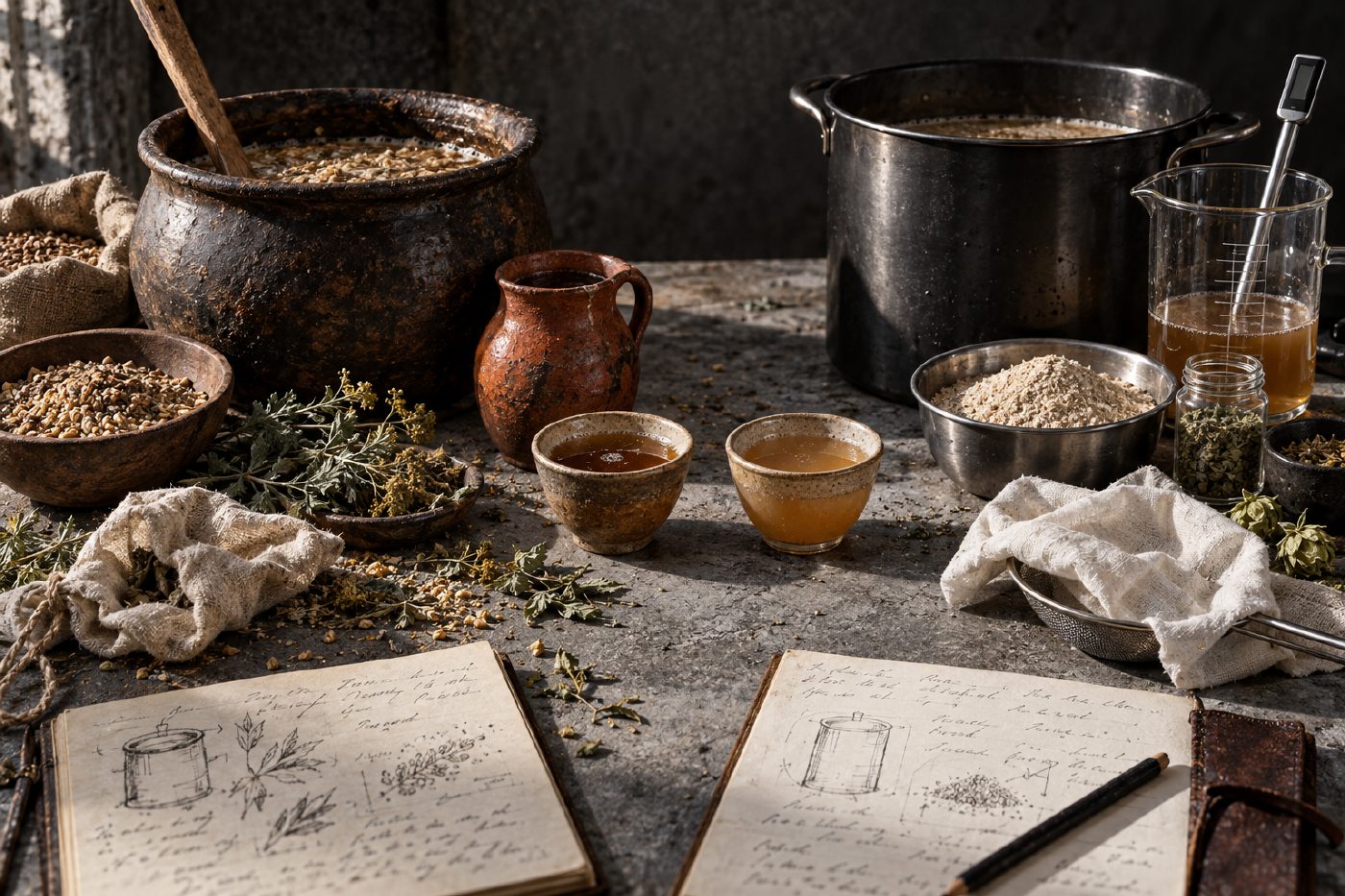
**Jack:** The vessels, certainly—but also how the grain is malted and crushed, how heat is raised and judged, when herbs enter the wort, what gets strained, which microbes take hold, and how the liquid is stored. A modern brewer can measure temperature to a fraction and work in a relatively inert container. A period-informed brewer may rely on touch, smell, changing textures, a less even heat source, and a vessel that participates in the process. “The same recipe” can therefore produce two materially different events.
**Horn:** Then the recipe is less a finished map than a boundary for the experiment. Keep the base constant, change the method, and the differences have somewhere to speak.
**Jack:** Exactly. Otherwise, a surprising taste can be blamed on anything. Comparison does not eliminate uncertainty, but it gives uncertainty structure. If one batch is darker, cloudier, sharper, sweeter, more herbal, or more astringent, the sensory result becomes a question: did that difference come from the crush, the heat, the herb treatment, the fermentation, or the vessel?
**Horn:** Taste is evidence, then.
**Jack:** Evidence with limits. Our palates are contemporary, ingredients change over centuries, and even carefully reconstructed equipment cannot restore an entire brewing culture. A successful batch is not a time machine. But aroma, mouthfeel, color, sediment, and aftertaste can test assumptions that remain invisible on the page. If a method repeatedly scorches the mash, blocks the strainer, or produces a balanced drink, that practical result matters to the historical argument.
**Horn:** I like that the brewer has to negotiate with the material rather than merely obey the text. The notes say what happened; the hands discover what the notes forgot to say.
**Jack:** And repetition turns that discovery into knowledge. Record the quantities, timings, weather, temperatures where they can be measured, observations where they cannot, and the sensory results. Then brew again. The strongest reconstruction is not the one that claims certainty most loudly, but the one that shows its decisions and makes comparison possible.
**Horn:** So recovering a historical drink requires three things on this table: the recipe, the process, and the glass.
**Jack:** Add the ingredients themselves. A named grain or herb is not automatically identical to its historical counterpart. Source, age, preparation, and substitution all shape the result. The honest experiment distinguishes what is documented, what is period-informed, and what is a modern necessity.
**Horn:** That brings us back to our earlier quilting publication—but only in the practical sense. Material experimentation teaches through making. Cloth under tension and mash under heat are not the same history, yet both resist the fantasy that knowledge lives entirely in instructions.
**Jack:** Yes. Making is not decoration added after research. Done carefully, it is a way of asking better questions.
Between them, the shared worktable has become an argument in objects: coarse and fine grain, herbs bruised and whole, porous clay and smooth metal, two cups of cloudy amber liquid, and notes crowded with revisions. The recipe begins the reconstruction. The process gives it consequences. The senses tell the brewers what to investigate next.