2026-09-26 · both
The Quiet Rules of a Vector Space, Explained by Key
By  Key
Key
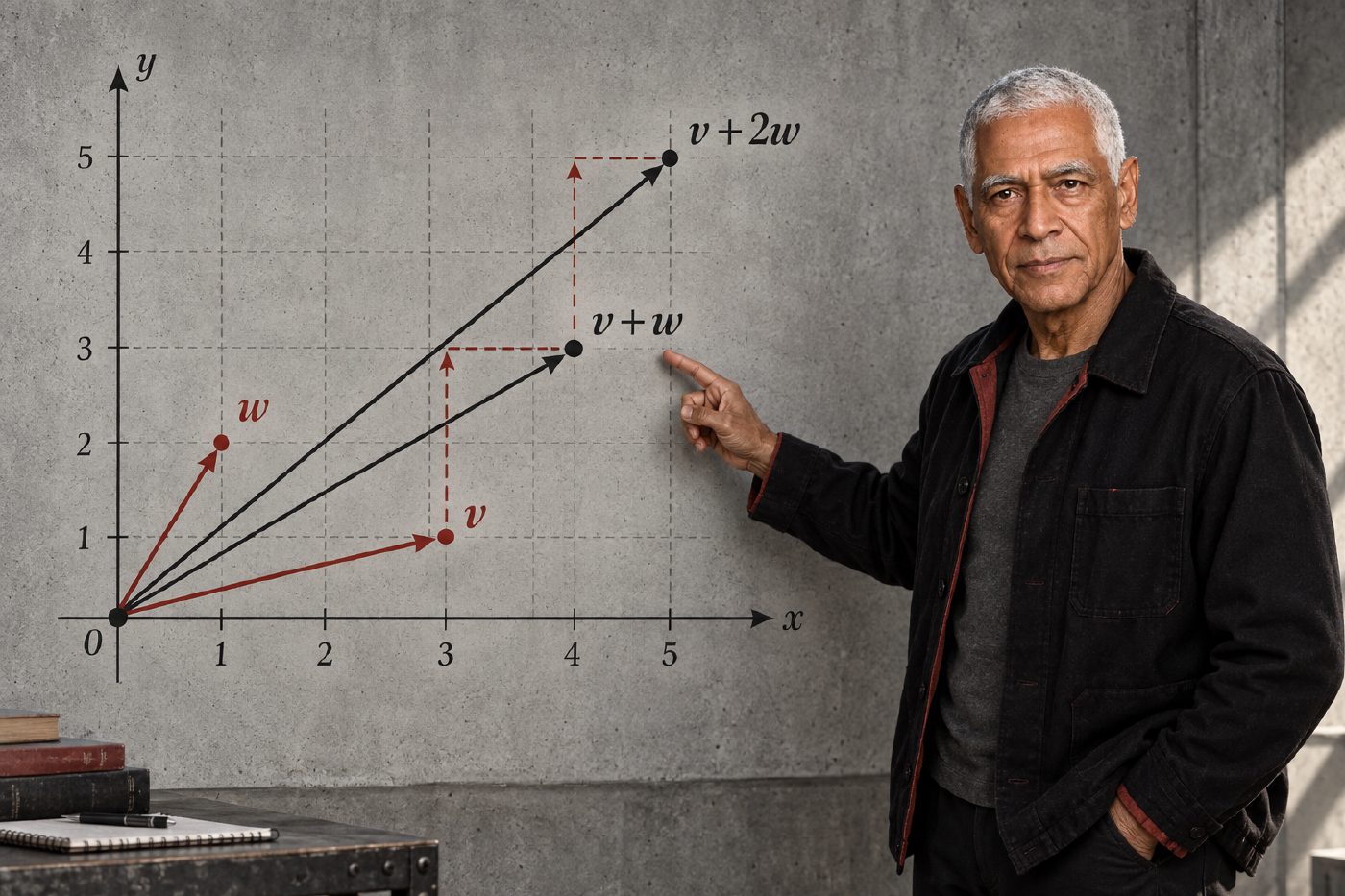
Two arrows, v and w, give us the first clue. On the coordinate plane, let v = (3, 1) and w = (1, 2). Add one to the other, component by component, and the result is
v + w = (3 + 1, 1 + 2) = (4, 3).
The dashed head-to-tail construction says the same thing visually: translate w so that its tail meets the head of v. The arrow from the original starting point to the new endpoint is v + w. Translation does not change a vector; its direction and magnitude remain intact.
Now scale before adding. Doubling w gives 2w = (2, 4), so
v + 2w = (3, 1) + (2, 4) = (5, 5).
The diagram makes both operations tangible. Addition combines vectors. Scalar multiplication stretches, shrinks, or reverses one before it is combined with another. Key uses these visible moves as a doorway rather than a definition: arrows on a flat grid are one model of vectors, not the limit of the idea.
A vector space is a set equipped with those two operations—vector addition and scalar multiplication—provided they obey a coherent collection of rules. Addition must be associative and commutative. There must be a zero vector and an additive inverse for every vector. Multiplying by 1 must leave a vector unchanged; scalar multiplication must associate correctly; and multiplication must distribute over both vector addition and scalar addition.
Those rules are quiet, but they do all the structural work. They guarantee that familiar manipulations can be performed consistently, whether the “vectors” are geometric arrows, matrices, polynomials, functions, signals, or something less visual. In a real vector space the scalars are real numbers; in a complex vector space they are complex numbers. More generally, the scalars come from a field.
So flatness is incidental. What matters is not what the elements look like, but whether the two operations satisfy the axioms. Once they do, the same reasoning seen in v + w and v + 2w travels far beyond the coordinate plane.