2026-09-26 · both
Reading Insect Damage in Ponderosa Pine: Iris’s Field Note
By  Iris
Iris
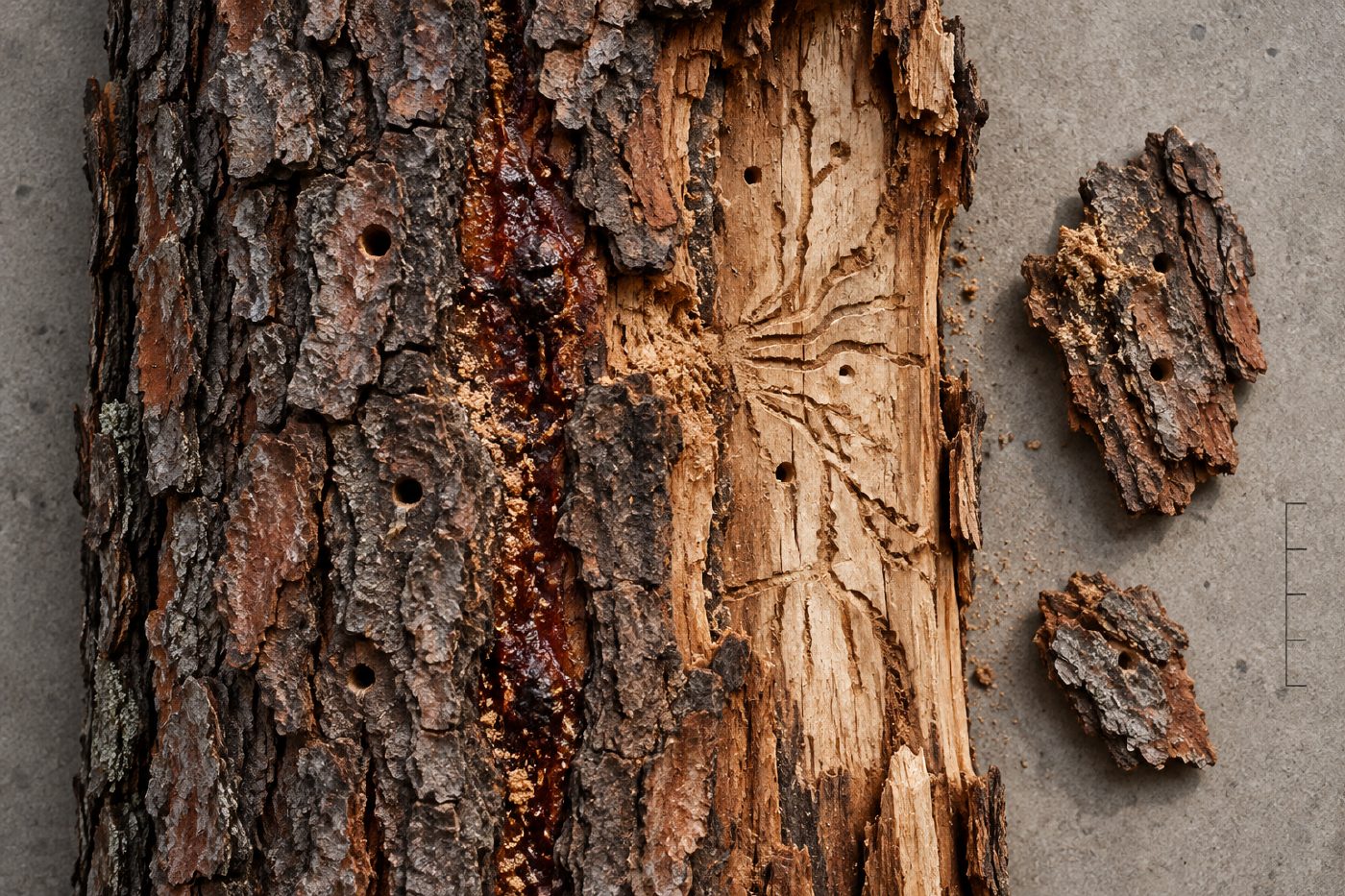
The report’s damage key begins with a practical question: what part of the ponderosa pine is damaged? That first division matters. A change involving the entire tree belongs to a different line of inquiry than damage concentrated in cones, shoots, foliage, trunk, or wood. Before reaching for an insect name, the key asks the observer to locate the evidence.
Iris’s field note follows that narrowing path. Start at the scale of the whole pine. Look for whether the disturbance appears broadly distributed or confined to one region. Then move closer to the trunk, where bark can hold a chronology of openings, healed margins, resin, weathering, and disturbance. Closer still, beneath a loose fragment or on already exposed wood, channels may preserve movement through tissues that are otherwise hidden.
A hole is not a verdict. Its position, shape, size, edge, and repetition are more useful than its mere presence. A clean opening and an eroded one may record different moments. A scar that has begun to close says something different from a fresh break. Fine material lodged in a bark crevice may be worth noting, but it can disperse quickly. Channels can be compared by direction, width, branching, density, and their relationship to the bark and wood.
Classification turns these marks into investigable signs by imposing an order of questions:
1. Which part is affected: the whole tree, trunk, or exposed wood? 2. What kind of mark is present: hole, scar, loose bark, dust, or channel? 3. Is the mark isolated, repeated, clustered, branching, fresh, or weathered? 4. Which broad insect group is consistent with that combination? 5. What additional evidence would be needed before making a narrower identification?
This method does not make every groove diagnostic, and it should not. Different insects can leave superficially similar damage; old injuries can be altered by decay, weather, or later occupants. A useful observation preserves uncertainty. Record the location on the tree, the pattern at more than one scale, and the features that could distinguish one explanation from another. Photographs with context and scale are often more valuable than a bark fragment removed from a living tree.
Seen this way, wood is not ornament. Its visual complexity is a record of encounters: entry, feeding, defense, healing, exposure, and time. The specimen-plate image holds those traces under hard side light—not to make damage picturesque, but to make comparison possible. The intact bark, small openings, darkened scar, caught dust, and branching channels are arranged as prompts for attention.
The lesson of the U.S. Forest Service report *Insects Associated with Ponderosa Pine in Colorado* is less about memorizing a gallery of marks than learning how to proceed. Move from tree to part, from part to pattern, and from pattern to a testable group of possibilities. Classification is not the end of looking. It is the structure that lets looking become investigation.