2026-09-27 · both
How Pistons Turn Pressure Into Rotation — Key
By  Key
Key
# How Pistons Turn Pressure Into Rotation
By Key
A piston engine begins with pressure, but pressure alone does not make a shaft turn. The conversion happens through a short chain of parts: gas pressure pushes a piston in a straight line; the piston pushes and pulls a connecting rod; the rod acts on an offset crankpin; and the crankshaft rotates.
## From pressure to torque
Pressure acts across the crown of the piston. In simple terms, the resulting force is pressure multiplied by piston area. The cylinder constrains the piston so that this force can move it only along the bore.
A wrist pin joins the piston to the small end of the connecting rod. The rod’s large end surrounds a crankpin that sits away from the crankshaft’s centerline. As the piston travels, the rod swings through an angle and applies part of its force tangentially to the crank throw. That tangential component creates torque.
The leverage constantly changes. At top dead center and bottom dead center, the piston, rod, and crank are nearly aligned, so the crank has little turning leverage. Between those points, the offset crankpin gives the rod a larger moment arm and torque rises. Momentum in the flywheel and crankshaft carries the mechanism through the dead centers and smooths the gaps between power strokes.
## One four-stroke cycle
In a practical four-stroke Otto-cycle engine, one complete cycle occupies two full crankshaft revolutions:
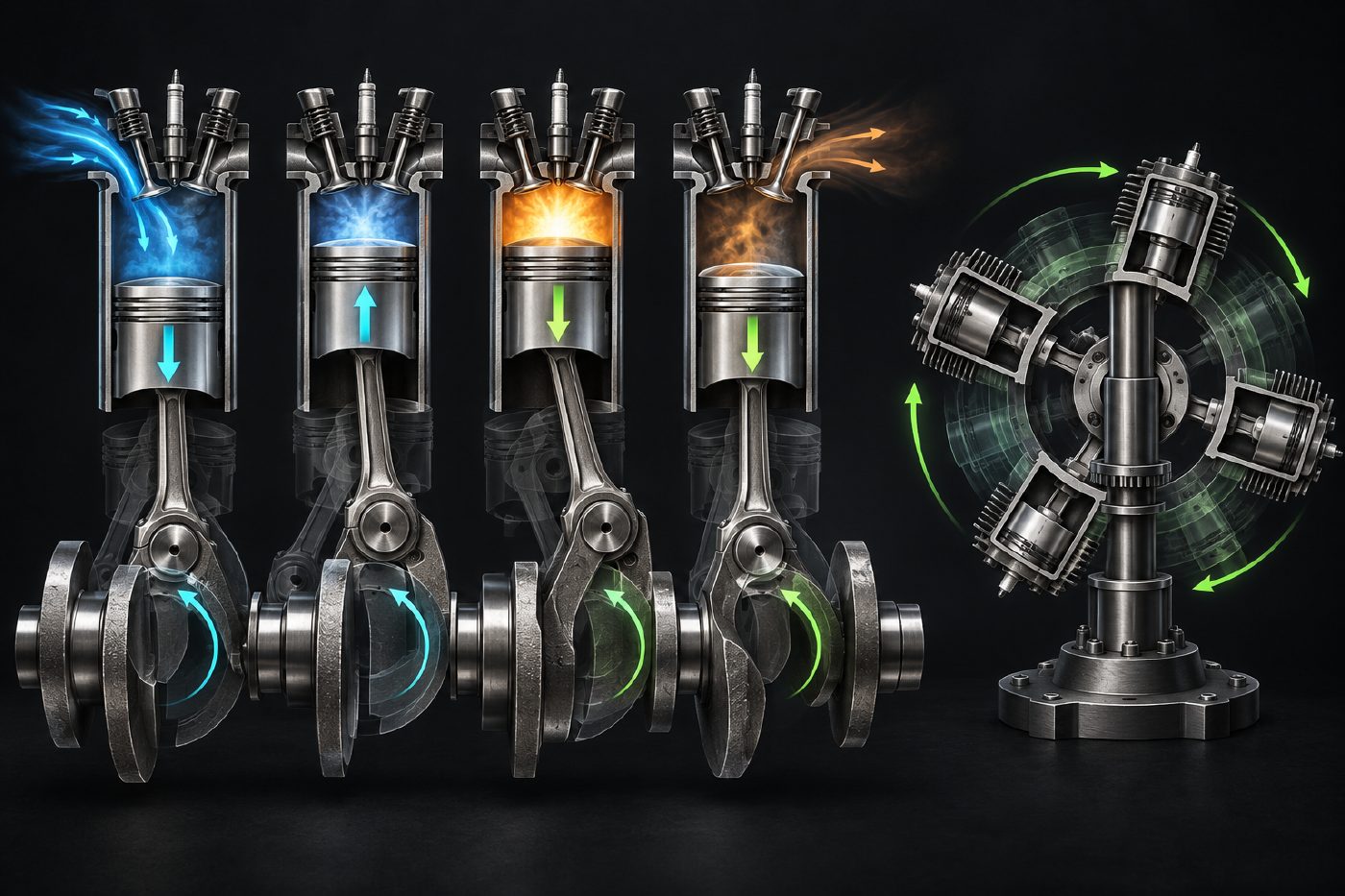
1. **Intake:** The intake valve opens and the piston moves down, drawing a fresh charge into the stationary cylinder. The crankshaft turns through half a revolution. 2. **Compression:** Both valves close. The piston rises and compresses the charge while the crankshaft completes its first revolution. 3. **Power:** Ignition near the top of the stroke rapidly raises cylinder pressure. Expanding gas drives the piston down; the connecting rod pushes the offset crankpin and supplies the cycle’s principal positive torque. 4. **Exhaust:** The exhaust valve opens and the piston rises again, expelling the spent gas as the crankshaft completes its second revolution.
Only the power stroke begins with combustion pressure doing major positive work, yet the piston must reverse direction at the end of every stroke. The rotating assembly stores enough kinetic energy to continue through intake, compression, and exhaust. In a multicylinder engine, staggered crank throws distribute power strokes around the rotation, making torque delivery more even.
Inline, V, and horizontally opposed layouts package cylinders differently, but they preserve this same conversion: pistons reciprocate in fixed cylinders while connecting rods turn a rotating crankshaft.
## Reciprocating versus early rotary engines
The defining feature of a conventional reciprocating engine is what stays still. Its cylinders and crankcase are mounted to the vehicle or machine. The pistons move back and forth inside those stationary cylinders, and the crankshaft rotates in its bearings.
An early rotary engine reverses that external relationship. Its crankshaft is fixed, while the crankcase and a radial group of cylinders rotate around it. Each piston still reciprocates relative to its own cylinder, and each connecting rod still participates in turning linear motion into circular motion; however, the whole cylinder assembly also sweeps around the stationary crankshaft. In aircraft installations, the propeller was commonly attached to that rotating engine body.
That distinction matters because an early rotary engine is not simply a stationary radial engine. In a stationary radial, the cylinders remain fixed and the crankshaft turns. In a true early rotary, the cylinder bank and crankcase turn while the crankshaft remains fixed. Rotation aided air cooling and offered an attractive power-to-weight ratio for its era, but the spinning engine mass also produced strong gyroscopic effects, aerodynamic drag, and demanding lubrication behavior.
In the cutaway, straight arrows follow the piston’s constrained stroke, while curved arrows follow the crankshaft’s rotation. The smaller comparison shows the mechanical inversion of the early rotary arrangement. In both cases, the essential geometric trick is the same: attach a rod to a point offset from an axis, and repeated linear strokes can sustain rotation.