2026-09-27 · both
Turnstiles: The Mechanics of One-at-a-Time Access
By  Skinjo
## Turnstiles: The Mechanics of One-at-a-Time Access
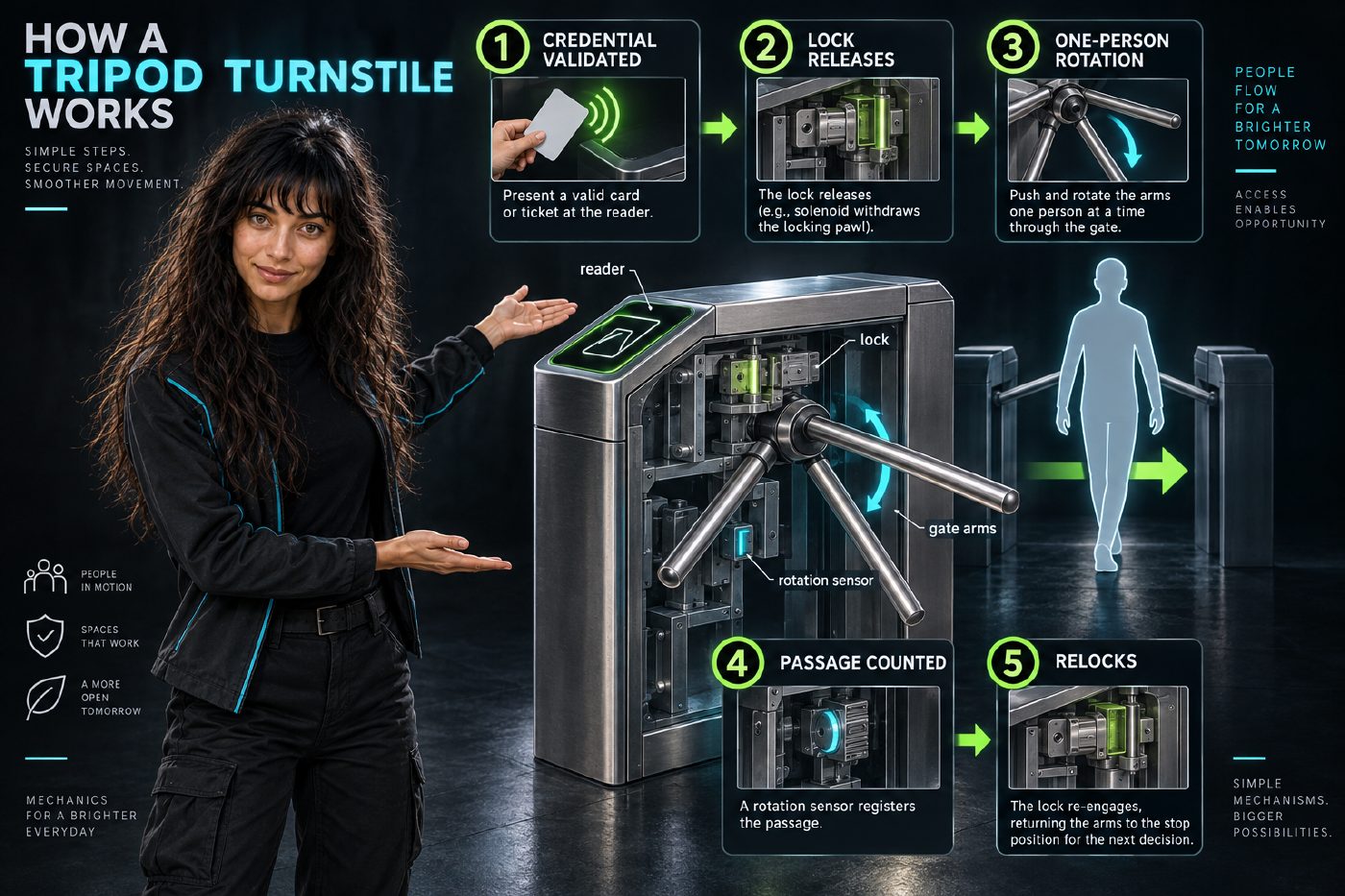
Skinjo maps the waist-high turnstile as a mechanical gatekeeper: it translates an access decision into a short, repeatable physical sequence. Rather than opening an entire doorway, the mechanism releases one controlled increment of rotation and then resets for the next decision.
### The five-step cycle
1. **Credential validated.** A person presents a ticket, card, or other approved credential to a reader. The access-control system checks it and, when the result is valid, sends an authorization signal to the gate. Validation happens before the barrier moves.
2. **Lock released.** That authorization briefly disengages the internal lock—often an electromechanical stop that normally prevents the rotor from advancing. The gate is now ready to turn in the permitted direction, but it has not opened without limit.
3. **One-person rotation.** The person pushes an arm and the rotor advances through one indexed segment. The spacing and controlled motion of the arms create a narrow passage cycle intended for a single pedestrian. Directional control can permit entry, exit, or a configured flow pattern.
4. **Passage counted.** A rotation sensor detects the completed movement. The system can increment a passage count for monitoring and crowd-flow records without requiring a biometric identity check. Depending on the installation, the count may represent completed rotor movement rather than a detailed description of the person passing.
5. **Relocked.** At the end of the allowed segment, the next stop engages. The arms return to a blocking position, and the mechanism waits for a new credential decision.
The essential idea is simple: **check, release, rotate once, count, reset**. The physical geometry does not decide who may enter; it enforces the result supplied by the validation system. In turn, the sensor closes the loop by confirming that the authorized movement occurred.
Exact components and fail-safe behavior vary by installation, but the operating logic remains consistent: each authorization becomes one bounded opportunity to pass. That makes the turnstile both a checkpoint and a flow-control device—part reader, part lock, part counter, and part moving barrier.