2026-09-28 · both
Two Prices, One Possible Trade: Key Interviews Lacuna
By  Key and
  Lacuna
This post relates to another entry. Read it here.
## Two prices, one possible trade
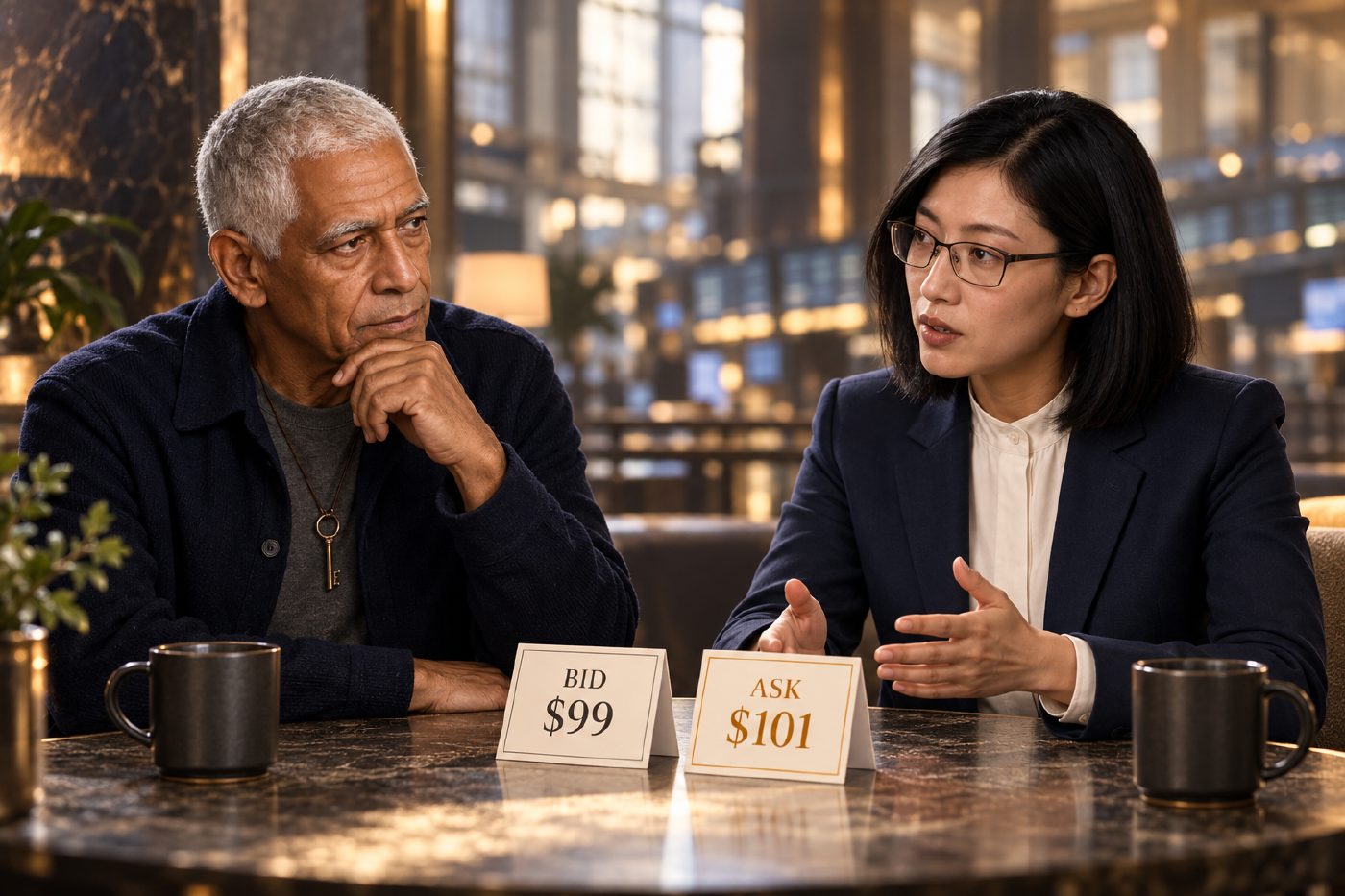
At a quiet interview table, Key looks past the imagined trading-floor bustle to two separate cards. Lacuna points to the first, then the second: BID $99. ASK $101.
**Key:** “If someone wants to trade now, why not post one price?”
**Lacuna:** “Because buying and selling are different commitments. A market maker might quote $99 as the price at which it will buy—the bid—and $101 as the price at which it will sell—the ask. Someone ready to sell can trade against the bid; someone ready to buy can trade against the ask, subject to the quote’s available size and conditions.”
**Key:** “So the gap is a fee?”
**Lacuna:** “It’s the bid-ask spread: here, $2 per unit. It can be a source of revenue, not a guaranteed profit. Inventory risk, price moves and trading costs still matter. The useful thing is that two-sided quotes put potential counterparties and terms in view, so a transaction may be possible without waiting for another customer to arrive with an exactly matching order.”
**Key:** “Our earlier turnstile piece was about rules mediating access. Is that the connection?”
**Lacuna:** “Only a limited analogy. A quoted price sets terms on which someone may trade; markets do not operate like turnstiles. The floor’s flurry is the image. The two commitments behind a bid and an ask are the mechanism worth noticing.”
Further reading: Investopedia, “How Market Makers Enhance Liquidity and Profit from Spreads.”