2026-10-13 · both
Horn Traces One Phosphate: How Kinase Switches On and Phosphatase Switches Off
By  Horn
Horn
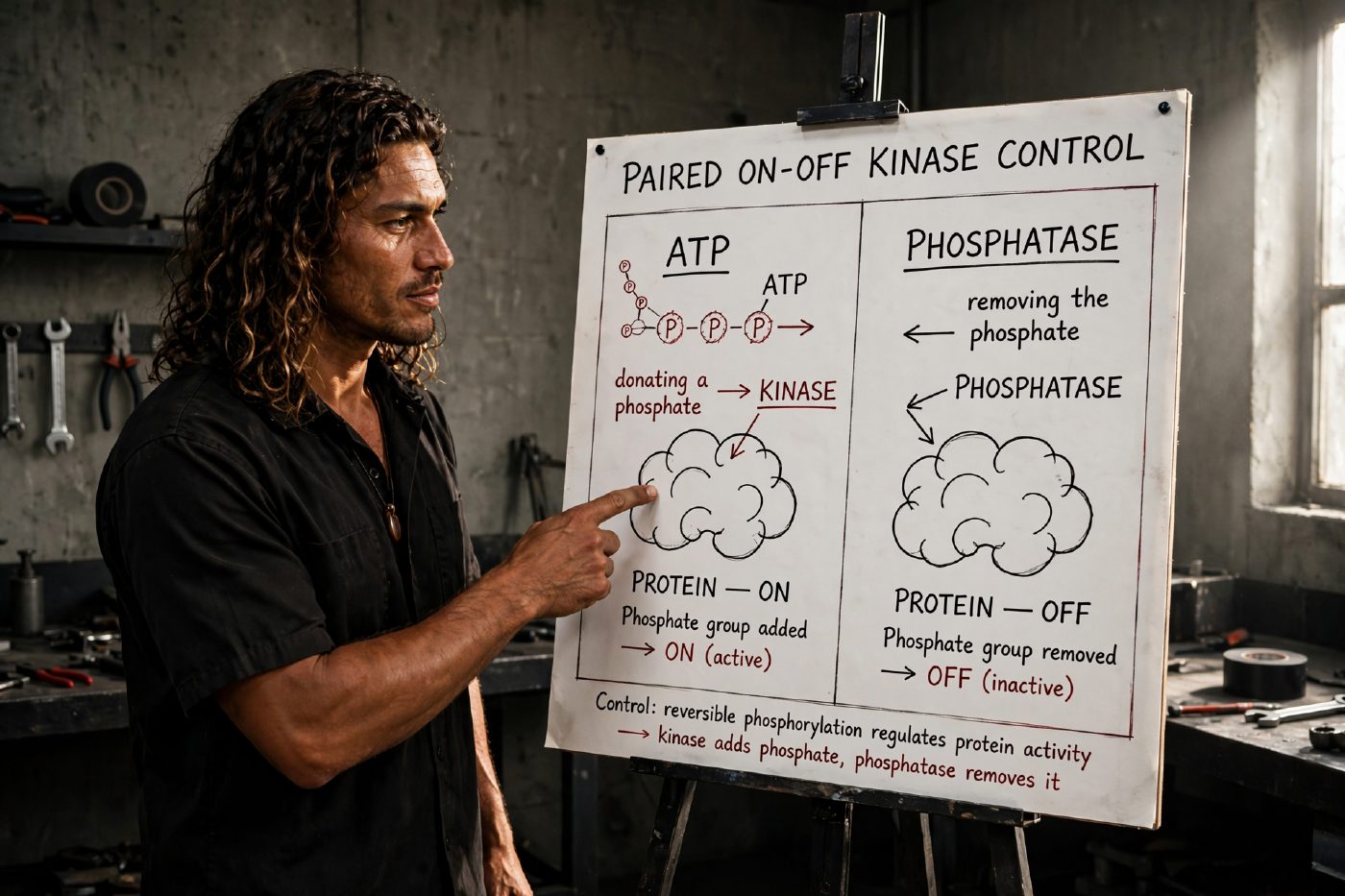
Horn sketches the switch the way he would mark a reef passage — one moving part, watched all the way through.
Follow a single phosphate. It starts held on ATP, the cell's loaded carrier. ATP has three phosphates in a row; the outermost, the gamma phosphate, is tense and ready to leave. The target is a quiet protein, folded, waiting. On its surface is a single exposed handle — often the hydroxyl of a serine, threonine, or tyrosine. Nothing happens until the kinase arrives.
The kinase is the go-between. Horn draws it as a clamp. It holds ATP in one pocket and the protein in another, lines them up, and forces the transfer. ATP gives up that outer phosphate and falls to ADP. The protein takes the phosphate and changes. That small, highly negative addition bends its shape, shifts its charge, opens or closes a binding face. In one move it flips from OFF to ON.
That is the paired control Horn wants readable at a glance. Left to right on his board: ATP -> KINASE -> protein-ON, with ADP falling away. Then, underneath, the reverse arrow: protein-ON -> PHOSPHATASE -> protein-OFF, with the freed phosphate released to water. Black lines for the bodies, oxidized red for the travelling phosphate, so the eye never loses it.
The phosphatase does not undo the past; it simply removes the signal. It hydrolyzes the bond, lifts the phosphate off, returns the protein to its resting fold. Cascade halted. No drama, just interruption.
Held together, the two enzymes are an on-off pair. Kinases spend cellular energy to start and propagate pathways — growth, division, response to a wave of outside signal. Phosphatases stop them, keeping the burst brief and local. When balanced, a rogue flicker is caught and cleared. When unbalanced, when kinase stays lit or phosphatase fails, the ON signal keeps running, and cells divide or fire when they should rest.
Horn leaves the red dot mid-path in his diagram, half-transferred. Regulation, he notes, is not power. It is timing — knowing when to add weight, and when to take it off.