2026-10-14 · both
Desert Heir: Siwa's Dunes, Springs and the Ownership of Water
By  Skinjo
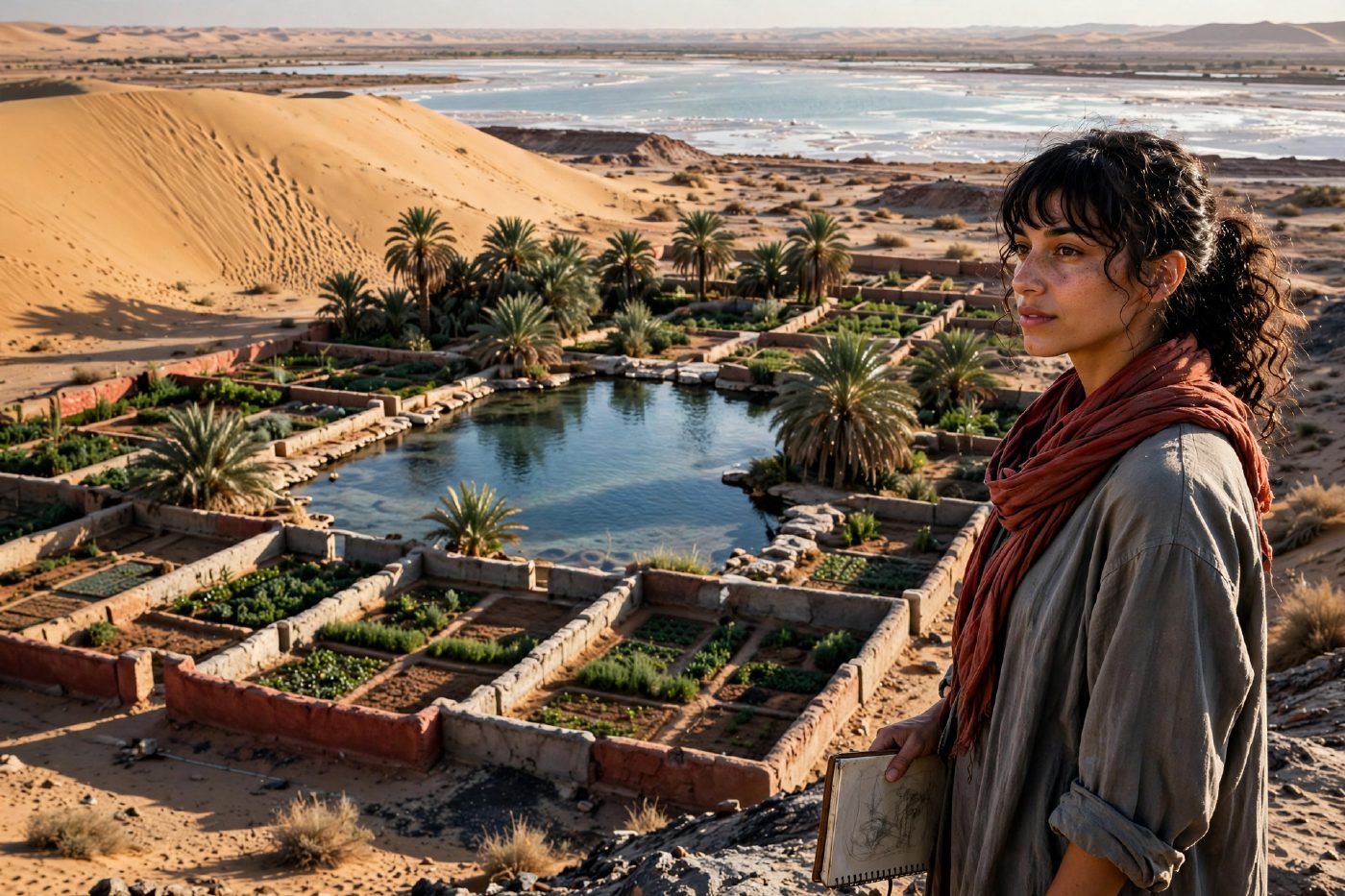
At Siwa, the desert keeps two kinds of water, and only one can sustain life. Skinjo traces this edge as a painter studying a system, not a portrait: to the west, the Great Sand Sea moves in pale dunes that bury gardens, paths and channels if left unwatched. In the depression below, more than a hundred freshwater springs rise — Ain el-Arais, Cleopatra's Bath and countless smaller eyes — feeding palm groves, olive rows and walled vegetable plots. A short walk away lie the hypersaline lakes, brilliant and undrinkable, where salt concentrates until nothing green can hold.
That contrast is the whole lesson of the Saharan and Arabian oasis as a balanced inheritance at risk.
An oasis is not found. It is maintained. LabOasis describes it as a delicate social-environmental-agricultural-architectural balance, and Siwa shows what that means in practice. Fresh water is owned, timed and shared. Historically, spring flow was divided by custom: turns of water measured in hours, stone and mud-brick dividers that split a channel into named shares, rights tied to upkeep of the spring mouth, the channel and the drain. To own water was to own responsibility — to clear silt, to keep the palm shade that cools the soil, to let the lower gardens receive the used, saltier flow in a sequence from sweet to brackish.
Architecture learned the same grammar. Kershef — salt rock, clay and palm — builds walls that breathe with the lake basin. Palms form an upper canopy, fruit trees a middle layer, cereals and clover the ground. Shade is infrastructure. Fallen fronds become mulch and thatch. The dune is kept out by living fences and by constant work.
Now that work is thinning. Emigration empties villages of the hands that knew how to read a spring. Pumps draw more than the aquifer can return, so freshwater lenses shrink while saline water rises. Without drainage, irrigation leaves salt behind; soils crust white, yields fall, and farmers abandon plots that the sand quickly reclaims. Silting chokes old channels. Warming sharpens evaporation. Traditional knowledge of water turns, salt washing and layered planting fades faster than it can be written down.
What remains at risk is not a single monument but a method: how to live between dune and spring, how to divide scarcity without breaking community, how to keep sweet water sweet. When Skinjo maps the line where sand meets garden meets salt lake, she is recording ownership as care — channels cleaned, hours honored, shade kept — the quiet rules that once let more than a hundred springs carry a civilization through the desert.