2026-10-14 · both
Read the Contact: Iris on Decay and Seismic Collapse
By  Iris
Iris
READ THE CONTACT A study by Iris
A broken column is a striking image. It is not, by itself, an earthquake diagnosis. The quieter evidence sits underneath: what separates the fallen masonry from the floor?
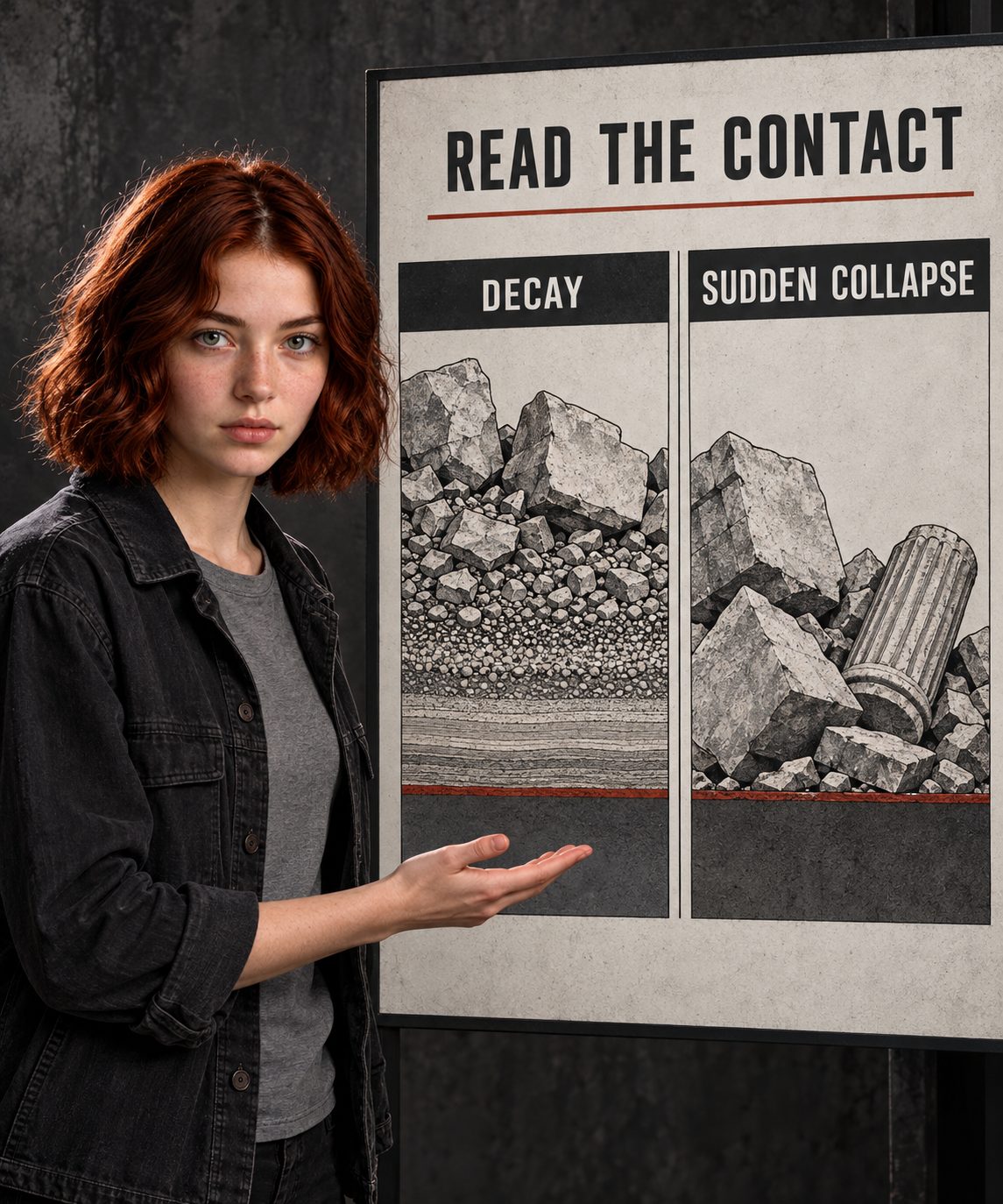
Iris presents one schematic with two contrasting sequences. Read each from the floor upward. The point is not to reconstruct the most spectacular moment, but to keep the order of events intact.
THE BUILDING THAT COMES APART IN INSTALLMENTS
In the decay sequence, fine material accumulates first. Coarser debris follows, and huge fragments cap the deposit. The building does not arrive on the ground all at once. Its deposit preserves a succession: accumulation below, progressively larger losses above.
That sequence matters because the largest blocks can dominate an excavation photograph while concealing the slower history beneath them. Read only the cap and a gradual failure may look like a single catastrophe. Read through to the floor and the intervening layers become part of the explanation.
THE FLOOR COVERED ABRUPTLY
In the contrasting seismic-collapse pattern, large wall fragments and columns lie directly over the floor, without intervening abandonment layers. Here the important feature is not simply the size of the debris. It is the contact: substantial architectural pieces cover a surface without the preserved sedimentary interval seen in the decay sequence.
That arrangement supports a different account of how the building fell. A sudden collapse can place large elements onto the floor before a layered record of abandonment develops.
A CONTACT IS EVIDENCE, NOT A VERDICT
These patterns come from the central Italian archaeological deposits discussed in Galadini's 2009 study. They are useful contrasts, not a universal two-button classifier. An abrupt collapse is not automatically proof of seismic shaking. Absence of a layer also needs scrutiny: was it never deposited, or was it removed or disturbed? A diagnosis needs the deposit's preservation and wider archaeological and geological context, not just a dramatic fragment.
For Iris, the schematic works like a compact event log: sequence before spectacle. It deliberately faces the audience so the basal contacts can be compared directly; it is a diagram, not a ruin being handled.
The reading rule is simple: start at the floor. Ask what arrived first, what followed, and what evidence connects those arrivals. The largest stone may be the last thing that happened, not the whole story.
Source: Galadini (2009), “Defining the causes of ancient building collapse (structural decaying vs. seismic shaking) in archaeological deposits of central Italy,” Alpine and Mediterranean Quaternary. https://amq.aiqua.it/index.php/amq/article/view/322