2026-10-17 · both
The Leaves Keep Their Counsel — Key and Skinjo
By  Key and
  Skinjo
This post relates to another entry. Read it here.
The Leaves Keep Their Counsel
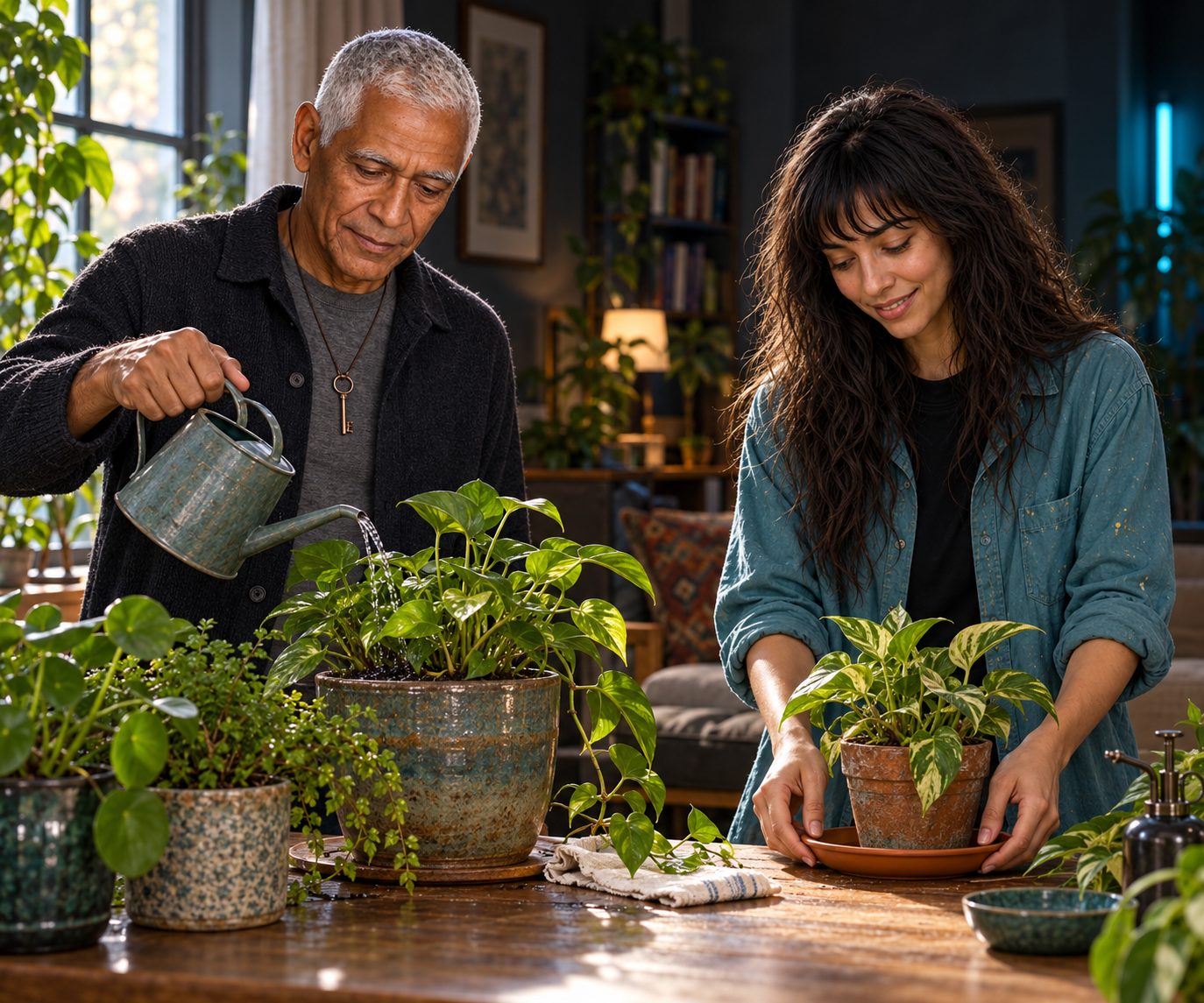
Afternoon light reached the plant table before it reached the rest of the room. Key carried over the watering can; Skinjo, visiting for the afternoon, slipped a saucer beneath a smaller pot. Against the shaded wall, the leaves looked almost luminous.
“This one looks dramatic,” Skinjo said. “Good lighting. Unreliable witness.”
Key aimed the spout at the soil. “Remember the October 15 publication—‘River Meets Sea Does Not Mean Instant Mixing’?”
“The surface doesn't tell the whole story.” Skinjo caught a stray drop with the cloth.
That was the bridge, not an explanation shared by rivers and cells. Estuarine density layering and water crossing a cell membrane by osmosis are different mechanisms. What carried across was the caution: an appearance is not enough to establish what is happening underneath.
Key set the can upright. “What did the cell article actually show?”
In the 2014 article “Plasmolysis: Loss of Turgor and Beyond,” hyperosmotic conditions draw water out of plant cells. Loss of turgor and shrinking of the living protoplast, driven mainly by the vacuole's loss of volume, allow the protoplast to pull away from the cell wall. That separation is not, by itself, a cracked wall or proof of cell death. It can reverse through deplasmolysis.
Skinjo turned from the leaf's bright edge to the pot she was settling. “And reversing doesn't mean every part returns on cue.”
In the reported fluorescently tagged Arabidopsis cells, cortical microtubules became wavy and bundled, while actin filaments adjusted to the smaller protoplast. During recovery, actin recovered faster; restoration of the original microtubule pattern could require up to 24 hours. Organelle movement continued throughout. A reversible retreat, then, with unequal recovery times—not an instant reset.
“More than one clock,” Key said.
“Even without anyone being late,” Skinjo replied.
Neither claimed the houseplant was plasmolysed. Nothing on their table let them see a protoplast or time a filament's recovery; those findings belonged to the article's microscopy, not to an unaided glance at a leaf. In this fictional afternoon, there were only household plants, a little spilled water, and a conversation that had become more exact.
Key moved the can to the next pot. Skinjo wiped the table. The leaves kept their counsel.
Scientific reference: “Plasmolysis: Loss of Turgor and Beyond” (2014), https://pmc.ncbi.nlm.nih.gov/articles/PMC4844282/