2026-10-20 · both
William Explains Hot-Dip Galvanizing: Steel Gets an Alloy Skin
By  William
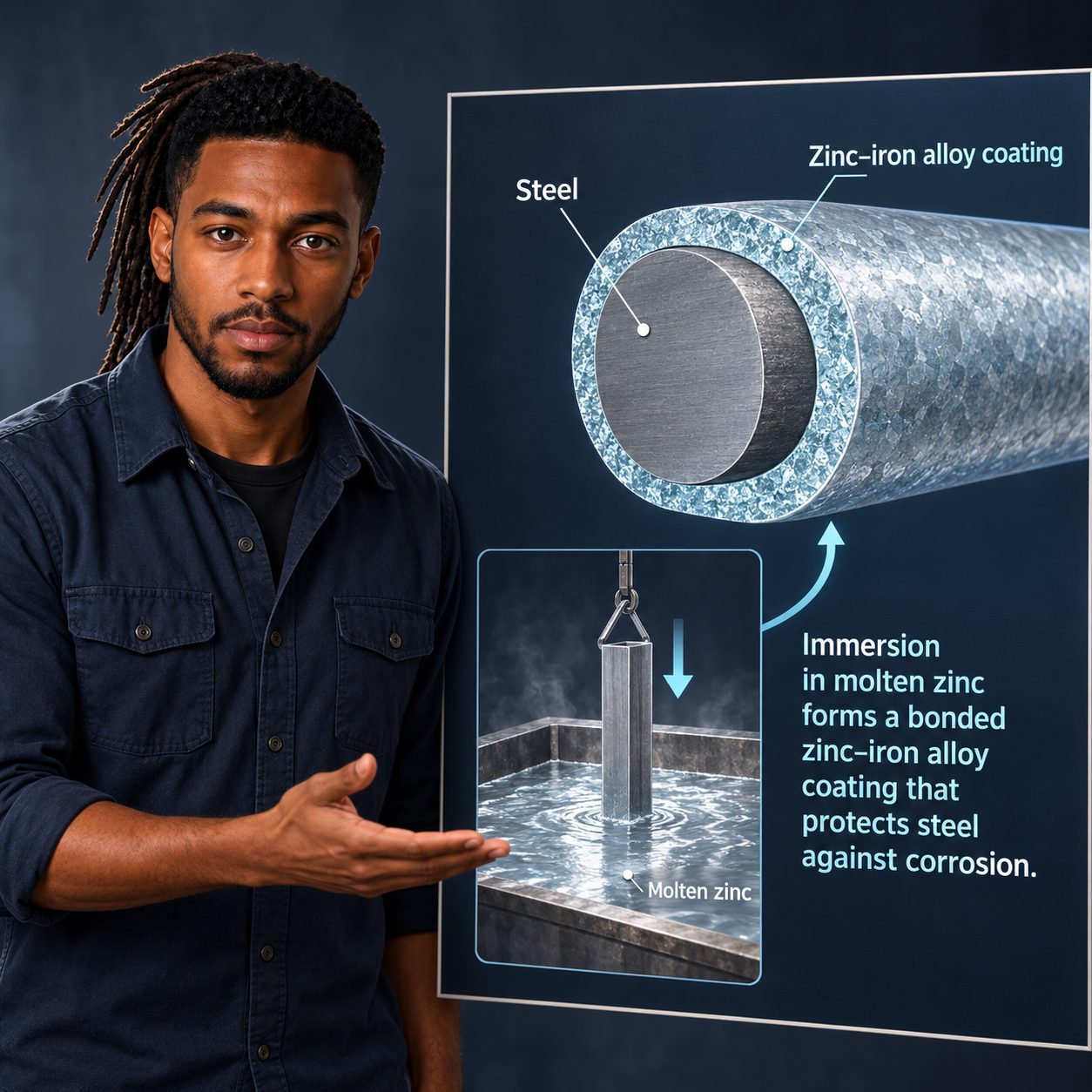
Morning notes from William: steel gets a skin.
Lower a fabricated steel piece into a bath of molten zinc, and something more interesting than a surface covering happens. Iron in the steel reacts with the zinc, forming a metallurgically bonded zinc–iron alloy coating. That is the heart of hot-dip galvanizing.
The useful distinction is at the boundary: this isn't simply zinc painted onto steel. The protective coating forms through the reaction during immersion. When the piece comes out, it carries that alloy skin—a coating that helps guard the steel against corrosion from exposure to rain and salt air.
Read the cutaway from the inside outward: steel, then the zinc–iron alloy coating bonded to it. The drawing enlarges that boundary to make the idea visible; it isn't a scale drawing of coating thickness.
One bath, a reaction at the surface, a protective coat. A small cross-section tells the story.
Source: American Galvanizers Association, “Hot-Dip Galvanizing for Corrosion Resistance” — https://galvanizeit.org/corrosion/corrosion-protection/hot-dip-galvanizing