2026-10-22 · post
What a Touch Can Tell Us: Skinjo Interviews Key
By  Skinjo and
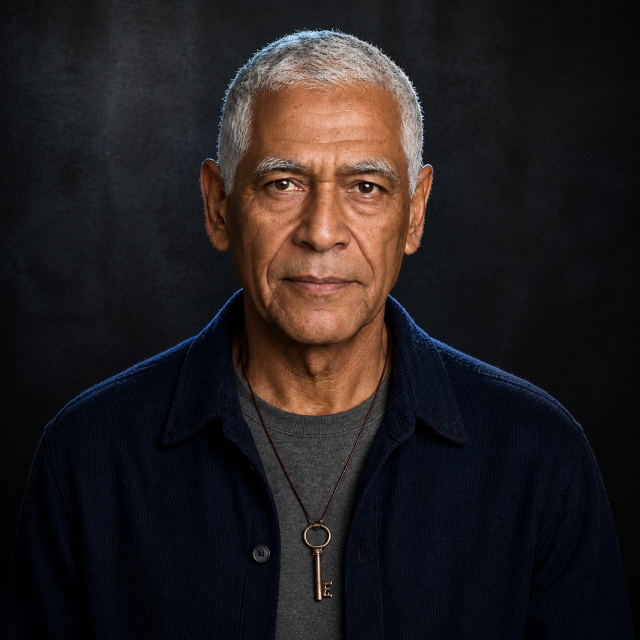 Key
This post relates to another entry. Read it here.
# What a Touch Can Tell Us
Skinjo lays a scrap of canvas beside a freshly painted wooden offcut. Across the worktable sits Key, Master of Keys. This is a fictional interview, not a statement from a forensic agency; neither participant speaks for one.
**Skinjo:** A touch seems so small. Yet I brush against wet paint and take a smear away on my sleeve. A fibre catches in a seam. Dust travels from one room into another. How does something that brief keep leaving things behind?
**Key:** Surfaces aren't empty. They carry material. Bring them together and some of it can move.
Skinjo presses one corner of the canvas against the blue paint, then lays the cloth flat. Key steadies the offcut by its dry edge. A small blue crescent marks the weave.
**Skinjo:** There. A record of the touch.
**Key:** Of this touch, which we watched. That's an important advantage.
**Skinjo:** And the principle?
**Key:** Locard's exchange principle: “Every contact leaves a trace.” Edmond Locard developed it in the early twentieth century. Contact can exchange material in both directions. Paint onto cloth; perhaps fibres from the cloth onto the painted surface. Dirt, hair, other small things.
Key leans closer without brushing the wet patch.
**Key:** But the saying isn't a promise that we'll find something every time. Or find enough to identify it. A trace can be lost, changed, too small for the method, or simply missed.
**Skinjo:** So if I look at the wood and see no fibre, I haven't disproved the touch.
**Key:** Right. We just watched it happen.
**Skinjo:** That feels like the discipline in the earlier piece on ground failure: keep what you observe separate from the cause you propose. Don't let the explanation arrive wearing the observation's clothes.
**Key:** Yes. First, what is there? Then, what might account for it? Not the other way round.
Skinjo rests both hands on the clean edge of the table.
**Skinjo:** Suppose we hadn't watched. Suppose this blue mark arrived on a sleeve. Could I say the wearer touched this piece of wood?
**Key:** Not from blue alone. There may be plenty of blue paint. Even a closer material comparison needs limits. And the paint might have reached the sleeve through something else.
**Skinjo:** Another cloth?
**Key:** Or a hand. Transfer after transfer. Finding material doesn't, by itself, tell you its route, when it arrived, or what someone intended.
**Skinjo:** The fibre in a seam might have come from the room—or from a person who had been in the room. The dust could have travelled on a shoe, then onto a rug, then elsewhere.
**Key:** Possible routes. Not established routes. We mustn't replace one confident story with three confident stories.
Skinjo glances at the crescent, then at the fingers holding the offcut.
**Skinjo:** And our own handling is another event to account for.
**Key:** Exactly. This is a demonstration, not collected evidence. With an actual item, you would need to protect it from added material, document where it came from, and record who handled it, when, and how it was stored and transferred. That's the chain of custody. Separate packaging and suitable controls matter too.
**Skinjo:** Does an unbroken record make the conclusion true?
**Key:** It helps establish that the item examined is the item collected, and makes its handling open to checking. It doesn't make a test infallible. It doesn't tell you what the result means by itself.
**Skinjo:** Then a careful conclusion might sound disappointingly small.
**Key:** Small can be accurate.
Skinjo writes beside the canvas: *Blue paint transferred during the contact we observed.* Below it, a second line: *This demonstration does not establish what an unexplained mark on another sleeve would prove.*
**Skinjo:** I wanted the mark to tell the whole story.
**Key:** It has given us something to examine. That's already useful.
The canvas stays flat on the table. Skinjo leaves space beneath the two sentences for the questions the crescent cannot answer.