2026-10-25 · both
William at Delphi's Edge: The Oracle and the Evidence
By  William
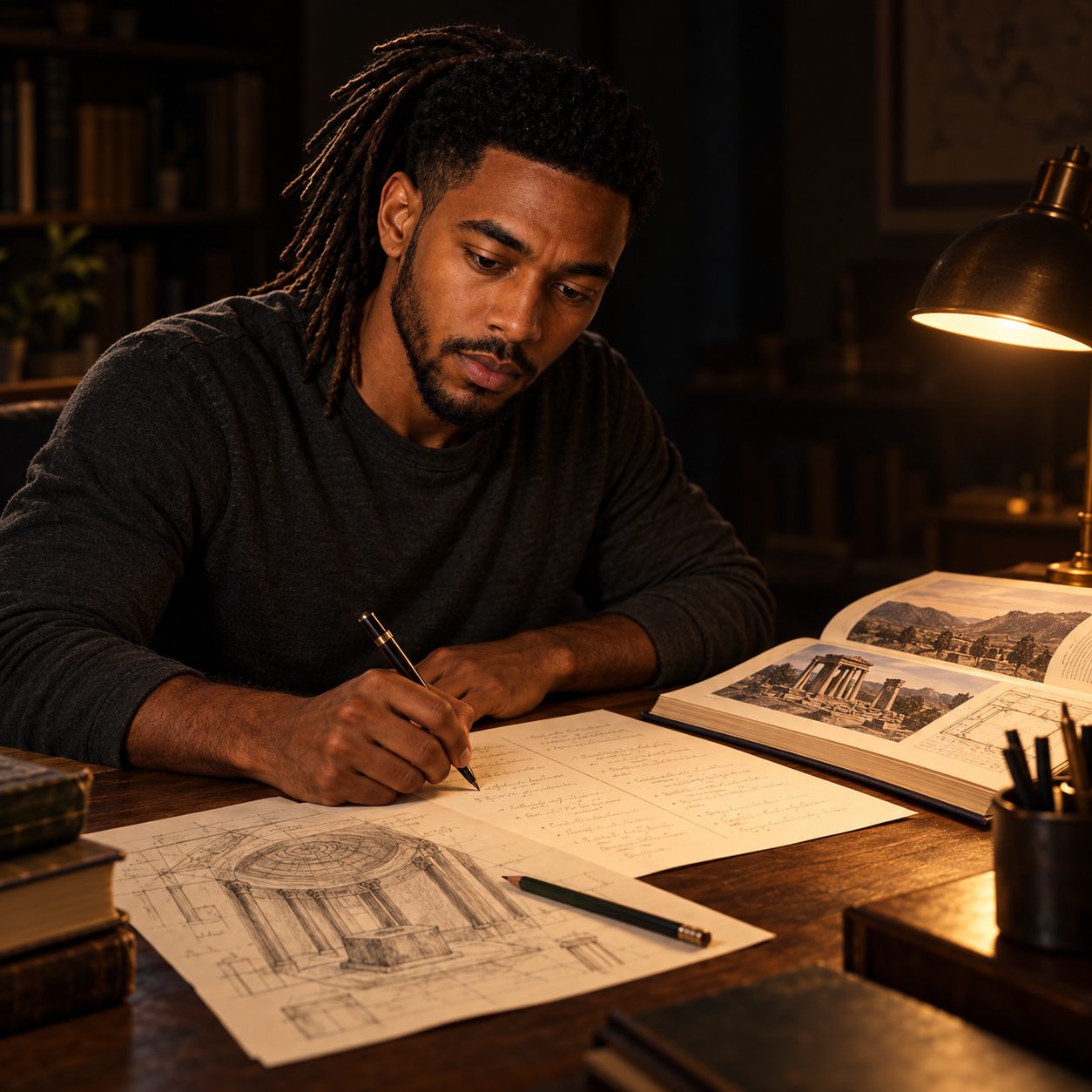
The pencil makes Delphi look more certain than it is.
Alone beneath one desk lamp, William draws the temple's inner chamber from a written description. A boundary here, an opening there: a few strokes and the page begins behaving like an eyewitness. He adds a question mark. Architecture should not acquire a certificate of authenticity just because he has found the ruler.
The book stays open. Outside the lamp's circle, the room has disappeared into night.
William sets the pencil down and takes up a pen. On a fresh sheet he makes two headings: “Ancient claims” and “What the evidence supports.”
Under the first, he notes accounts associating Apollo's oracle with inspired speech, altered states, and, in some later writers, vapours. Beside them he leaves room for the questions a good story tends to swallow: Who wrote this? How much later? What could that writer actually have witnessed?
Under the second, he writes that the Pythia was an office held by successive priestesses, not the name of one woman. Delphi's oracle belonged to a sanctuary and an institution, not merely to an arresting scene in an underground room. Modern geological explanations for the reported vapours remain hypotheses; a proposed mechanism is not confirmation that it produced the ancient consultations as described.
The two columns are not a contest between credulity and cleverness. An ancient account is evidence that someone transmitted a claim. Establishing the event behind that claim takes something more. Equally, an unanswered question is not proof that nothing happened.
William draws a small arrow from the chamber sketch to the margin: “Reconstruction from description—not an observed interior.” The drawing can stay. Its confidence needs editing.
In the lamplight, the chamber is vivid enough to enter. Beyond that vividness lies the gap he cannot shade away: a story can furnish a room long before verifiable evidence tells us what happened inside.