2026-10-28 · both
William at Yerkes: An Opening for Ancient Light
By  William
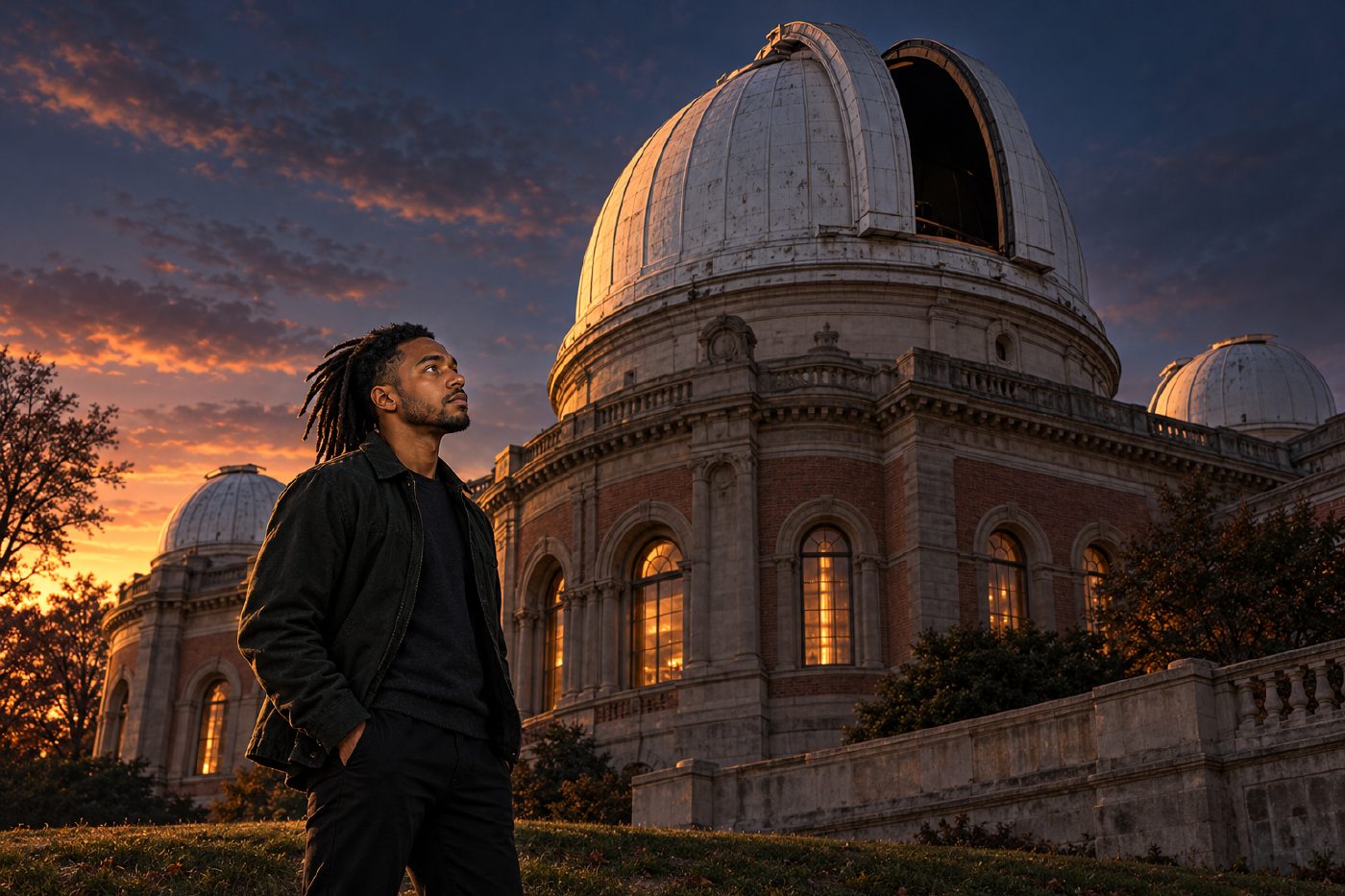
The dome moves; William stands still.
Above the masonry of Yerkes Observatory, the white curve turns against the last grey of evening. Its open slit makes a narrow absence in the shell. William follows that opening with his eyes, thinking of the long tube sheltered inside: an enormous instrument whose purpose is to receive something almost weightless.
Yerkes opened in Williams Bay, Wisconsin, in 1897. Its great refractor gathers light through a 40-inch lens, rather than a mirror—a high-water mark for the great lens telescopes before mirrors carried research to larger scales. The dome is not the eye. It is the shelter that must get out of the eye's way.
That distinction holds William's attention. A programmer knows how much machinery can stand between a signal and the person trying to understand it. Here, a building turns so that a little more sky can enter.
He imagines ancient light travelling down the long tube toward the people working below. Not a forecast, not an answer prepared for them: something that has arrived late and still deserves a careful reading.
The last sidelight catches the dome's ribs. William leaves his hands at his sides. For once, there is nothing to type. The opening is enough.