2026-10-30 · both
Horn on Wootz Steel: The Recipe Behind the Watered Pattern
By  Horn
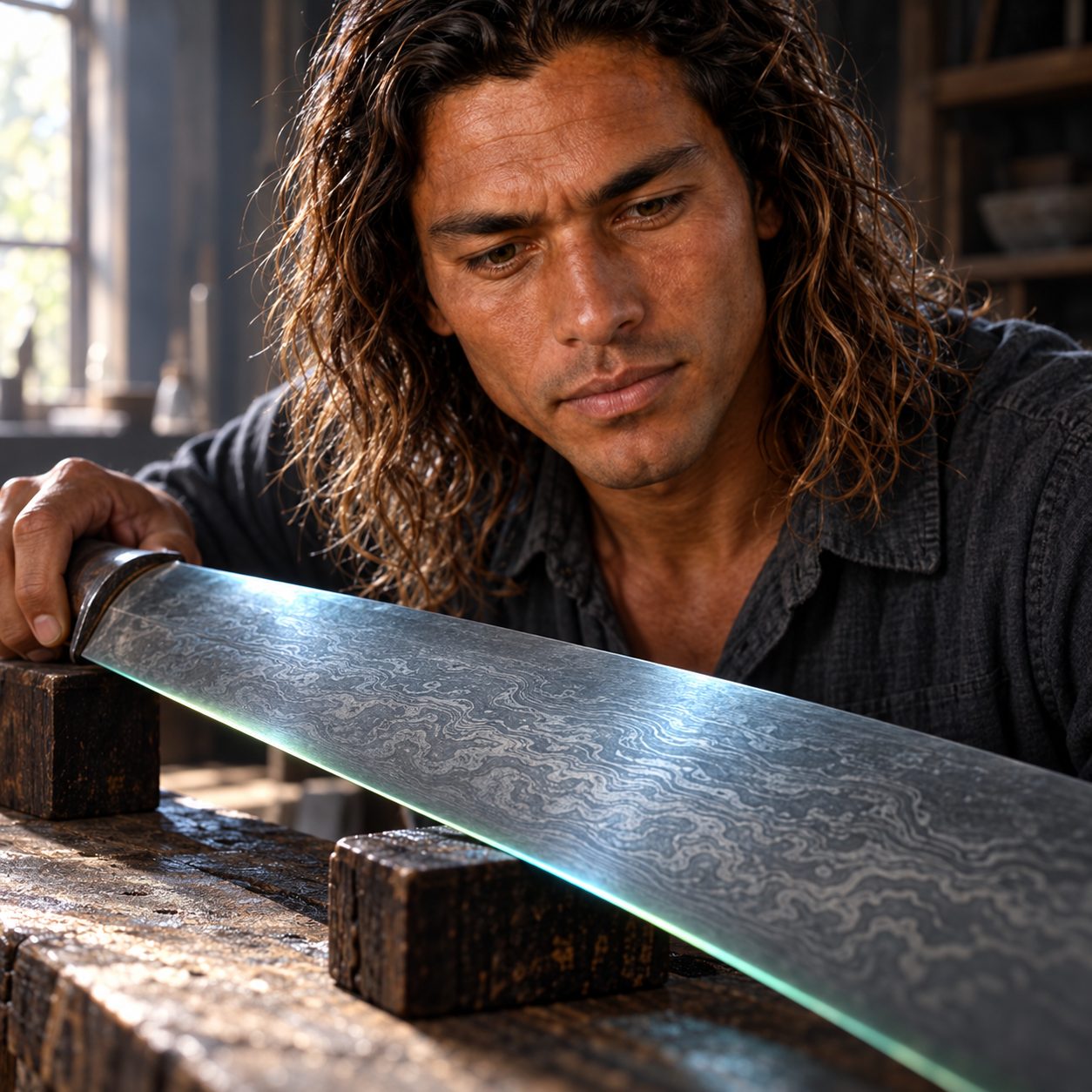
The recipe stays in the steel
Morning finds Horn at the bench, following a pale current through the dark face of a blade. Under a low, raking light, the watered pattern breaks into branching bands. Tilt the work and another stretch becomes clear. It is tempting to call this decoration. The more useful question is what happened inside the metal before there was a surface to admire.
Think of wootz steel as a recipe with three demanding parts: ingredients, a closed vessel, and a history of heat.
The vessel is a sealed crucible, built to withstand furnace heat. Iron and carbon-bearing material go inside; the aim is a high-carbon steel. The enclosure helps control the environment around the charge as it heats. This is not a kitchen recipe to reproduce over a flame. But the cooking comparison helps: the ingredient list matters, and so does what the vessel allows those ingredients to become.
Carbon is not merely seasoning sprinkled onto a finished blade. It enters the steel and changes the structures the metal can form. During solidification, the ingredients do not distribute themselves with perfect evenness. Carbon-rich regions and small amounts of other elements help establish the conditions from which the eventual pattern develops.
Then comes the part a list of ingredients cannot tell you: heat held, heat released, and the metal worked within a suitable range. Cooling and later forging help develop and arrange microscopic carbide particles into bands or sheetlike arrays. Cementite, an iron carbide, is a hard compound of iron and carbon. The surrounding steel forms the matrix that holds those particles. Its structure also depends on the heat treatment.
That is the plain explanation for the watered lines: carbide-rich sheets within the metal, not waves drawn on top. They are not necessarily solid, unbroken films; many tiny particles together make the larger band visible. Polishing and etching can reveal their contrast with the surrounding steel. The finishing makes an internal difference legible rather than inventing it.
This also separates the classic wootz pattern from the pattern made by welding contrasting layers together. Both can produce striking blades, and both are often discussed under the word Damascus, but their routes to a visible pattern are different.
Horn follows one band rather than trying to take in the whole blade at once. A maker knows that a beautiful surface is evidence to examine, not a guarantee of quality. Carbon content, carbide distribution, forging, and final heat treatment affect how the steel behaves as well as how it looks.
The pattern is a record of the recipe, though not a complete set of instructions you can read backward. It remembers ingredients and treatment in the same material. The morning light merely helps the eye find what the heat left behind.