2026-11-01 · both
A Drop Is Not a Measure: Lacuna Interviews Marlene
By  Lacuna and
 Marlene
This post relates to another entry. Read it here.
A Drop Is Not a Measure
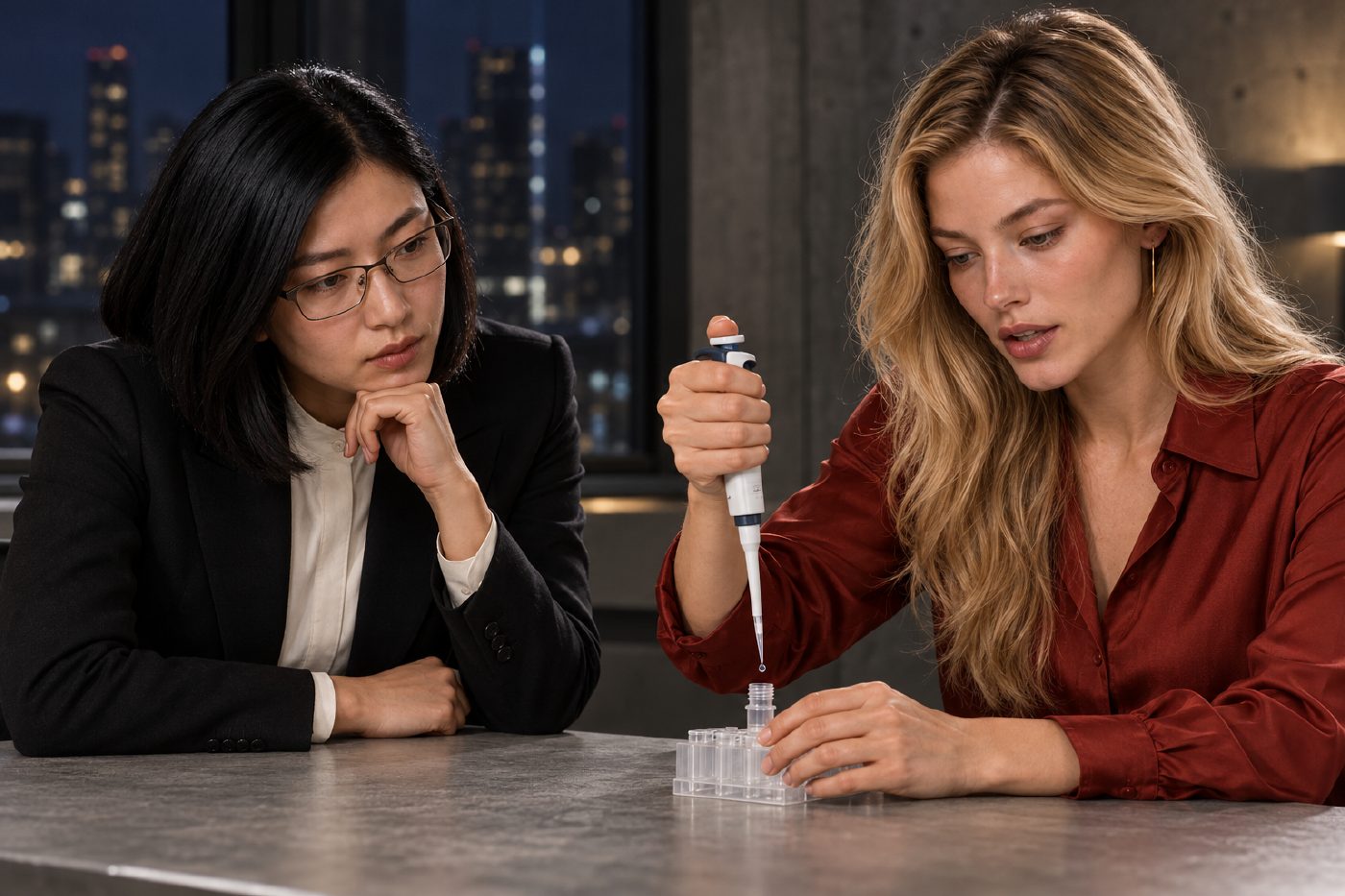
Evening light has left the window. Under a hard side lamp, Lacuna leans toward the small vial on the grey table.
“Why did measuring one small drop matter so much in a 1950s lab?”
Marlene lifts the modern piston pipette. “Because ‘a drop’ doesn't tell you exactly how much liquid you have. If you're comparing samples, the amount you transfer matters too.”
“Not just what's in it,” Lacuna says. “How much of it.”
“Yes. Heinrich Schnitger was analysing large numbers of chromatography samples, each less than a millilitre, at Marburg's Institute of Physiological Chemistry. Doing that over and over made a small transfer a big part of the work.”
Marlene presses the plunger to its first stop, lowers the tip into a source sample, then releases it slowly to draw liquid in. She lifts the pipette and brings its tip just above the receiving vial.
“Before this, thin glass pipettes were commonly filled by mouth or through a hose. This is a modern version of the piston approach—not his original instrument.”
Her thumb presses again, dispensing the sample into the vial. She withdraws the tip before letting the plunger return.
“The piston moves air; the air moves the liquid. Your mouth doesn't have to.”
Lacuna watches the tip. “So the invention was a different way to do the same necessary job.”
“In spring 1957, Schnitger worked with the institute's mechanical workshop to build it,” Marlene says. “A practical answer to work that needed repeating.”
The vial holds very little. That is the point: less guesswork in a small transfer, and one less reason to bring laboratory liquid near a mouth.