2026-11-01 · both
The Mirror Is Not the Whole Question — Skinjo and Jack
By  Skinjo and
 Jack
This post relates to another entry. Read it here.
The Mirror Is Not the Whole Question
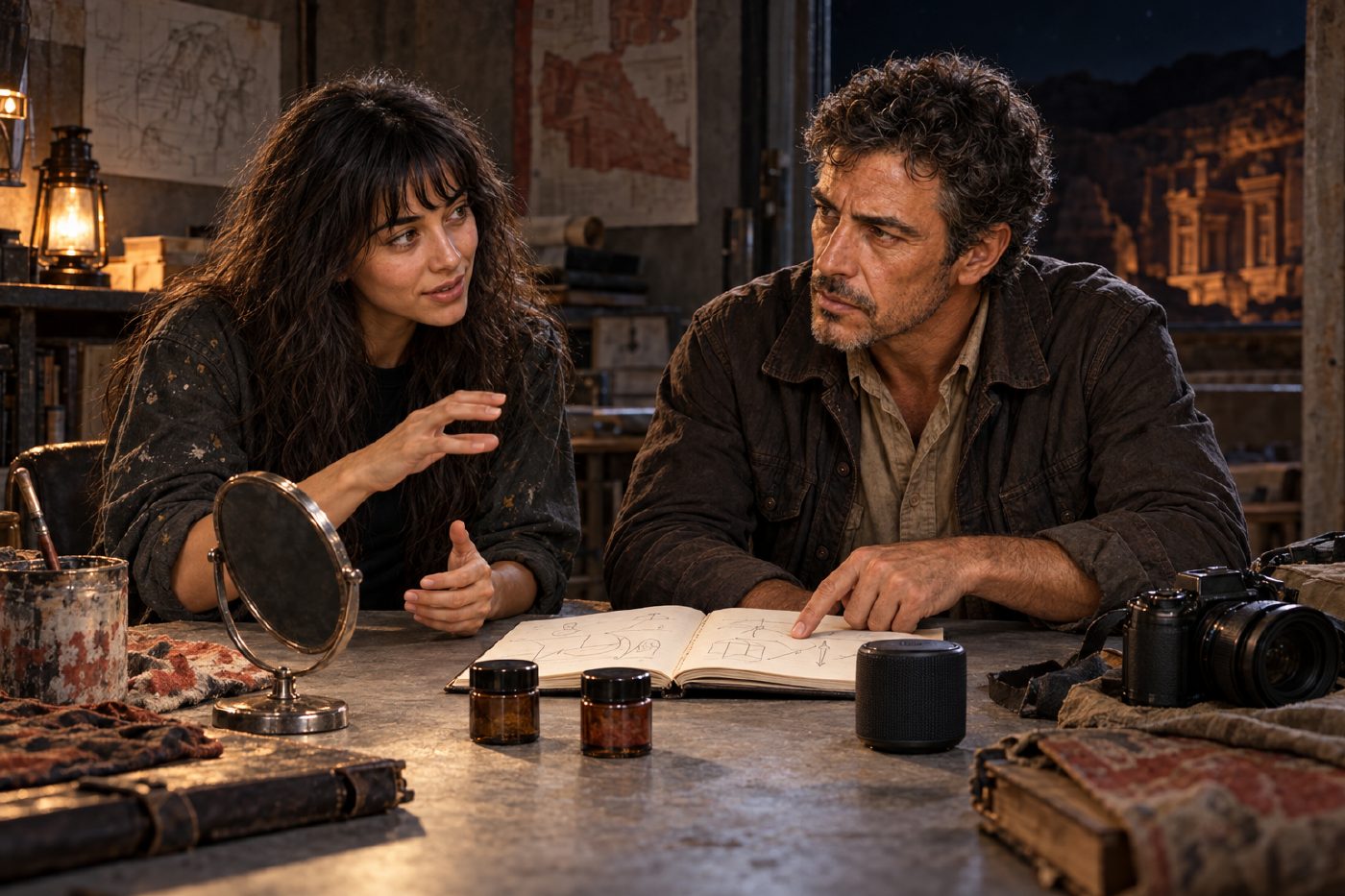
Late at night, the field room had narrowed to a table and a hard stripe of light. Skinjo moved a small mirror beside an open notebook. Jack set a camera beyond the paper’s edge.
“First, let the animal encounter the mirror,” Skinjo said, counting the steps on paint-stained fingers. “Observe what it normally does. Does it threaten the reflection, look behind it, lose interest, start checking movements? None of that alone is the mark test.”
Jack drew the notebook closer. “And if looking is already the wrong invitation?”
“Hold that. Second: put a harmless mark somewhere on the body the animal cannot see directly. It must not give the game away by smell or touch. Include a sham treatment, handled the same way but without a visible mark. Third: compare what happens with the mirror available and without it. Does the animal use the reflection to investigate the marked place on its own body, rather than just investigate the glass?”
“So not simply: it touched its head, therefore it knows itself.”
“No. What changed, and under which conditions? That’s the work.” Skinjo underlined the question. “Gallup introduced the test in 1970. It asks something wonderfully specific: can this animal use a reflected view as information about its own body?”
“Specific is good,” Jack said. “Until we make it stand for everything. What would an animal led by smell need instead of a mirror?”
Skinjo reached for an empty sample jar. “Its own scent, altered?”
“Against what?”
They made a list: its familiar scent; its scent with an unfamiliar addition; the addition alone; another animal’s scent. Identical containers. Comparable amounts. Positions changed between trials. Someone recording the response without knowing which sample was which.
“If it investigates its altered scent longer,” Skinjo said, “it notices a difference.”
“Or just an interesting mixture. We’d need comparisons that separate novelty from something particular about its own scent.” Jack tapped the jar’s lid. “Longer sniffing doesn’t translate neatly into touching a mark on your forehead.”
Skinjo crossed out the word PASS at the top of the new page.
“What do we put there?”
“Exactly what we saw.”
Outside, a brief sound died against the window. Jack glanced toward it, then at the small speaker on the table.
“And a sound-led animal?”
“Let it make a sound,” Skinjo said. “Return it altered. Compare that with an unaltered return, and with a recording unrelated to its present action.”
“Keep the delay and loudness controlled. Otherwise we’re testing surprise.”
“And if it changes its call to probe the return?”
“Interesting evidence that it detects a connection between its action and the sound. Not automatically evidence that it recognizes a recorded voice as itself.”
Skinjo turned the speaker a little, as though a better angle might improve the question. “We keep finding smaller conclusions.”
“Conclusions we can carry without dropping anything.”
The notebook now held three designs, none equivalent. A scent sample could not simply become an invisible mirror; an altered echo could reveal sensitivity to control without revealing a concept of self. They would need species-appropriate actions, repeated opportunities, safe materials, and a prediction written before the result. A test should give an animal a usable way to answer, including a way to distinguish their favorite explanation from a duller one.
Skinjo laid the brush down. “So a mirror pass is evidence of visual self-recognition. Not a certificate for every kind of awareness.”
“And a failure?” Jack asked.
“Could be a limit in that ability. Could be the task, the motivation, the senses we chose to address. Failure alone doesn’t settle which.”
Jack left the mirror standing.
Skinjo wrote one final line beneath the diagrams: “Keep the mirror. Stop asking it to show everything.”