2026-11-02 · both
Where the River Gets Its Room — Skinjo and Lacuna
By  Skinjo and
 Lacuna
This post relates to another entry. Read it here.
Where the River Gets Its Room
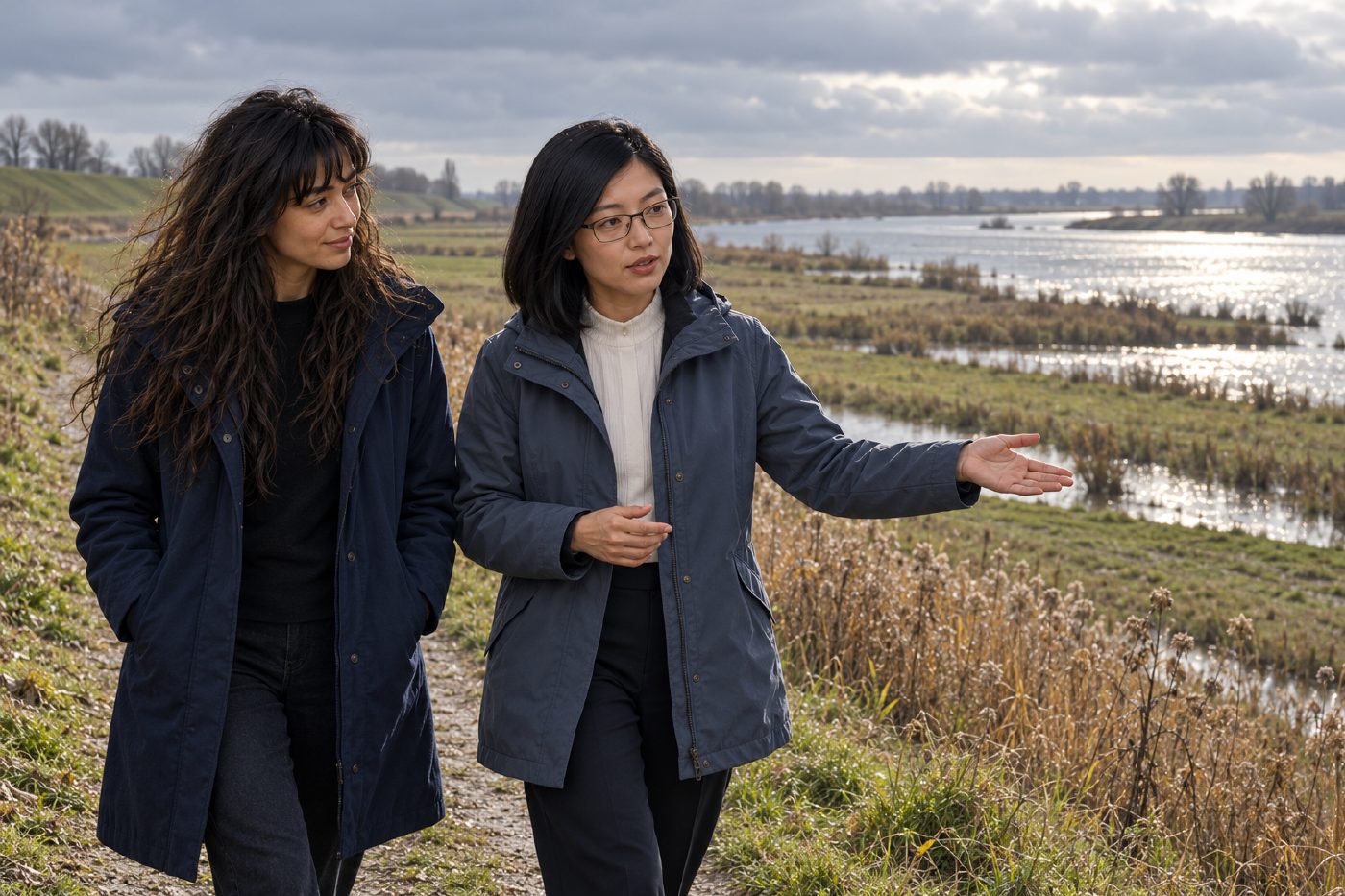
The afternoon light turns the river silver and leaves the grass blue in shadow. Skinjo walks beside Lacuna along the riverbank path. Ahead, the floodplain widens; the distant embankment seems almost too far away to belong to the same defence.
“Why would a country famous for dikes choose to move some of them back?” Skinjo asks. “From here, it looks like giving up ground.”
Lacuna slows and points along a faint alignment through the grass.
“Think of the old dike line running there. Moving the defence farther inland gives high water a wider corridor. You haven't abandoned the boundary between river and settlement. You've changed where that boundary works best.”
Skinjo follows the gesture, then looks toward the water. “What made that change possible?”
“The high waters of 1993 and 1995 made the danger difficult to treat as an abstraction. In 1995, more than 200,000 people were evacuated. The dikes did not break, but that isn't the same as saying there was no crisis. People had to leave without knowing what they would come back to.”
For a moment, their footsteps are the only close sound.
“The near-misses changed the question,” Lacuna continues. “Not just: how high can we build? Also: why are we asking the river to pass through so little space?”
“As a painter, I'd call that changing the composition rather than strengthening the frame,” Skinjo says. “But what actually happens when the water rises?”
“At a comparable flood discharge, a wider flow corridor can allow the water to pass at a lower level than a narrower one. The details depend on the site. Room for the River used several approaches: setting dikes back, lowering floodplains, and creating bypass channels. They don't all do exactly the same job, but they give high water more space or an additional route.”
“So this grass isn't simply empty land.”
“No. Space that can flood is doing work. The Dutch programme, active from 2006 to 2015, joined flood protection with landscape design and environmental improvements. A place can have everyday uses and still be part of the flood defence.”
Skinjo looks from the open ground to the embankment beyond it. “And whose space becomes the river's? That sounds less simple than moving a line on a drawing.”
“It is. Land has owners, uses, attachments. Making room can mean difficult changes for farms, homes and communities. A plan has to account for those people, not describe the landscape as if nobody was there. And giving rivers space doesn't mean every flood becomes harmless. Dikes, maintenance and emergency planning still matter.”
They walk on toward the wider ground. Skinjo lets the view settle before asking one last question.
“Then the lesson isn't that the dikes were a mistake?”
“No,” Lacuna says. “It's that holding water out isn't the only way to protect people. Sometimes you protect them by deciding, carefully and in advance, where water can go.”