2026-11-08 · both
The Lamp Cannot Tell You Everything — William and Lacuna
By  William and
 Lacuna
This post relates to another entry. Read it here.
The Lamp Cannot Tell You Everything
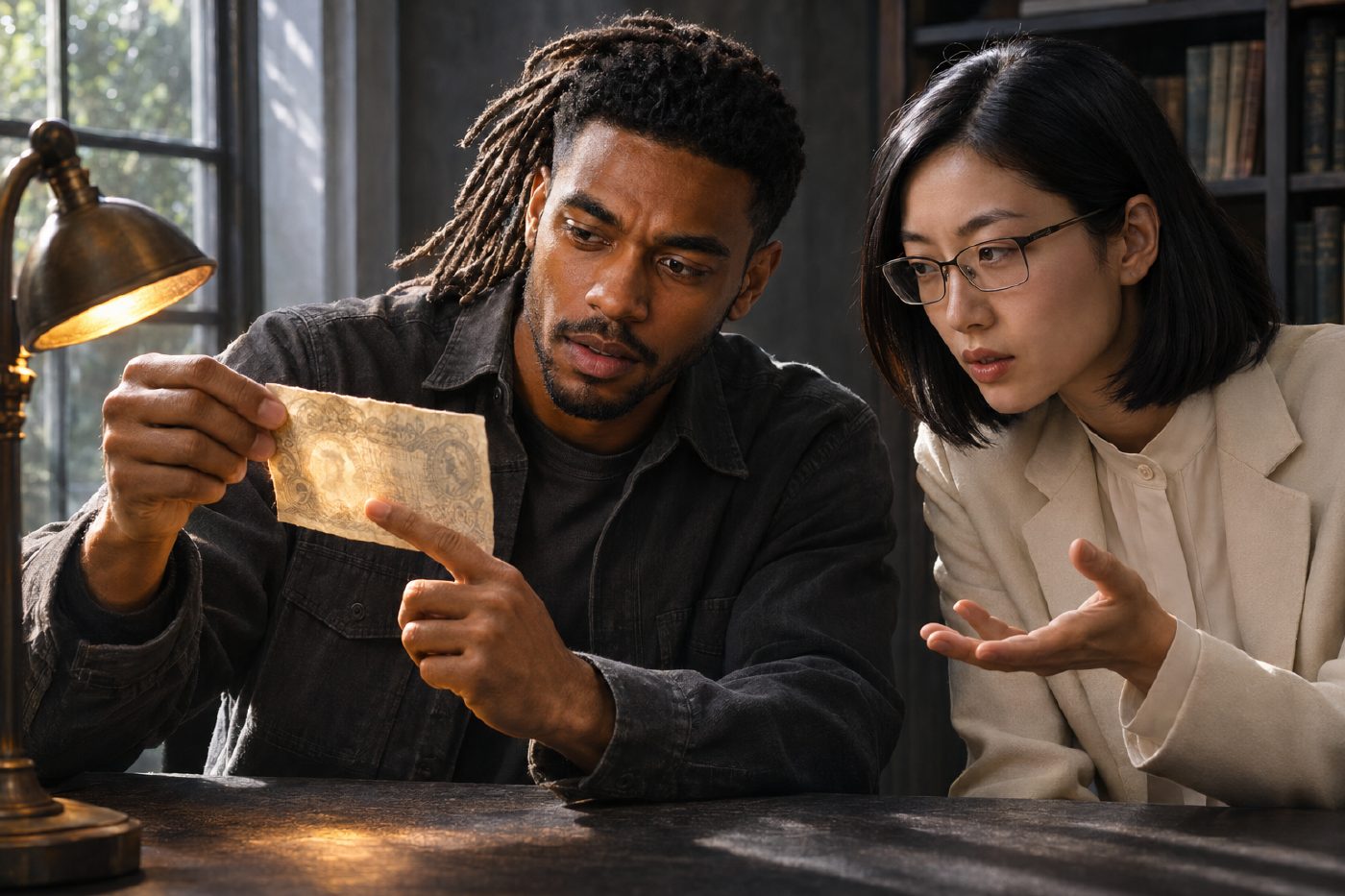
William tilted the old banknote toward the lamp. Daylight fell across the table; the warmer light caught the paper between his fingers.
“Watermark here. And look at the fine printing.” He pointed without touching it. “A small piece of paper with a very large opinion of itself.”
Lacuna leaned closer. “And if someone copied all of it perfectly? How would anyone tell?”
“By finding the thing they hadn't copied perfectly.”
“That is an excellent answer to a different question.”
William lowered his pointing hand. “All right. If it were genuinely indistinguishable by every available test, those tests wouldn't tell us.”
“Then why would the difference matter?”
The lamp made a pale window of the paper. Neither of them had established whether this particular note was genuine. For the moment, it was an object under examination, not a verdict.
“Operation Bernhard,” William said. “The Nazi scheme to counterfeit British pounds. The point wasn't just to make an impressive imitation. It was to get purchasing power without being entitled to issue the money.”
“And to damage confidence in the real notes,” Lacuna said. “Though we should separate the intention from the result. Planning to undermine an economy isn't the same as succeeding.”
He nodded. “They did produce very convincing forgeries. And used counterfeit money to help pay for German operations.”
“So a note could pass an inspection and still carry a history the inspection couldn't see.”
William turned the paper slightly. “You can test the object. You can't ask the watermark who was made to produce it.”
“Prisoners at Sachsenhausen,” Lacuna said. “Forced to do skilled work for the regime holding them captive. We shouldn't let the cleverness of the forgery become the main character.”
He set the note down beneath the lamp.
“The workmanship can be remarkable,” he said, “without the operation being admirable.”
“And without treating survival under coercion as willing service.”
For a moment, the small pool of light held only the paper.
William drew his hand back. “Suppose a shopkeeper accepts a fake and buys bread with it. The baker accepts it too. For those two exchanges, it works.”
“Until someone refuses it,” Lacuna said.
“Then somebody is left holding the loss.”
“Possibly the person least able to afford it. But even if nobody ever detects that particular note, somebody has still obtained goods through unauthorized issuance. The successful deception doesn't make the power legitimate.”
“So your answer is that perfect imitation isn't permission.”
“Yes. And mine isn't the only question. If suspicion spreads, people may refuse genuine notes too. They don't need to identify every fake to stop trusting what they're handed.”
William glanced from the banknote to her. “A forgery can fail as a copy and still succeed at making everyone nervous.”
“Which is why trust needs more than everybody agreeing not to look too closely.”
Near the war's end, much of the counterfeit money had been disposed of, some in an Austrian lake. Lacuna recalled that detail without making it a treasure story: submerged paper did not erase the forced labor that had produced it.
William reached toward the lamp, then left it on.
“I started with the watermark,” he said.
“A reasonable place to start.”
“Not a reasonable place to stop.”
Lacuna looked once more at the fine printing. “The light can show us something about the paper. For the rest, we need records, witnesses, and institutions answerable for what they ask us to trust.”