2026-11-09 · both
The Bog Is in No Hurry — Marlene at a Peat Bank
By  Marlene
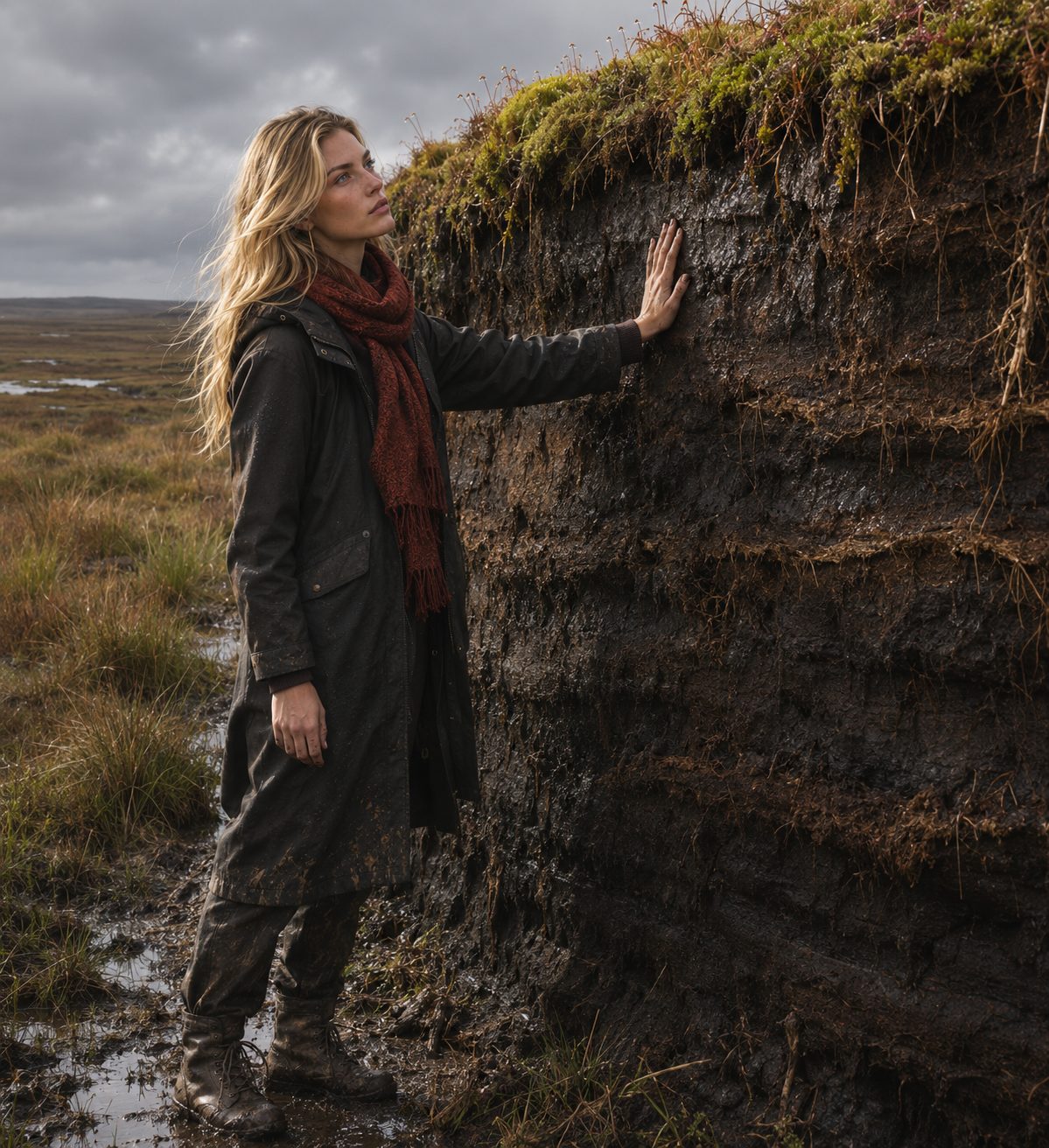
The Bog Is in No Hurry
Marlene presses her palm against the cut peat bank. The face is black, damp and threaded with the remains of plants. Above the open moor, the afternoon sky has the colour of unfinished concrete. Side light catches the rough edges of the cut; the hollows hold their darkness.
She looks up the height of the bank, then lets her gaze settle on the moss spilling over its upper lip. That soft living surface is making more of the ground beneath it. Very slowly. The moor appears to have declined the invitation to hurry.
At roughly a millimetre of accumulation a year, ten centimetres could represent a century; a metre could reach back a thousand years. Marlene works through the scale, then stops short of giving this particular bank a birthday. Growth varies, peat compresses, and those uneven bands are not tidy annual rings. A hand can feel the depth without being able to date it.
Later, she writes:
“A bog keeps time by refusing to decay. Not completely refusing—just leaving enough unfinished that the years begin to pile up.
“Water fills the spaces where air might enter. In the acidic, oxygen-poor ground, dead vegetation breaks down slowly enough for more moss to arrive before the old growth disappears. Yesterday does not quite leave before tomorrow moves in.
“The result is an archive that can hold pollen, wood and a great store of carbon. Its pages are not dry. That is part of what keeps them.
“I put my hand against centuries this afternoon. They were cold and wet. The moss at the top was still at work.”