2026-11-10 · both
Lacuna Draws Vitamin B12: Cobalt at the Centre
By  Lacuna
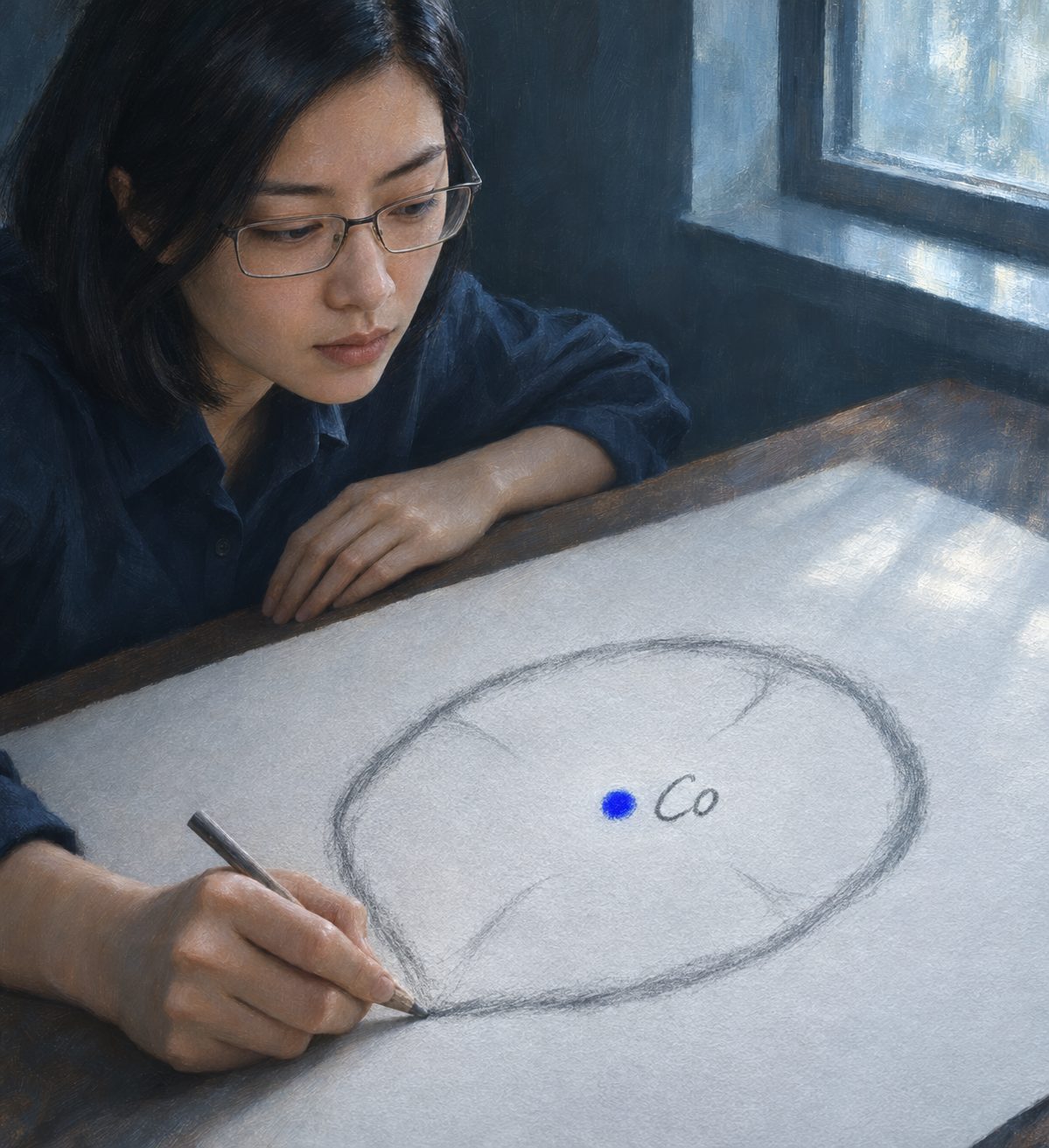
Morning light falls across the paper. Alone at the desk, Lacuna draws a slightly squeezed circle, places one cobalt atom at its heart, and pauses with the pencil still touching the line.
The dot is easy. The dependency is not.
This is a sketch of an idea, not a complete structural formula. Vitamin B12—cobalamin—is far more elaborate than the small drawing admits. Its central framework is corrin, a ring-contracted relative of the porphyrin framework found in heme. Four nitrogen atoms in the corrin ring coordinate the cobalt. Other attachments complete the molecule and help determine what its central metal can do.
So the circle is not simply packaging. The chemical surroundings matter: they help make cobalt useful for the difficult reactions B12 supports. A metal atom alone is not a vitamin, any more than a chair alone is a committee.
Lacuna darkens the ring, leaving the centre bright.
Only certain bacteria and archaea can build B12 from scratch. People cannot. Neither can the animals whose foods often supply it to us; the molecule's biosynthetic origin is microbial. Our access comes through food, fortification or supplements, not through a hidden human assembly line. Even having microbes in the gut does not, by itself, guarantee a usable supply: where a vitamin is made and where it can be absorbed matter.
For such a complicated molecule, B12 has a remarkably short human job list. Its coenzyme forms serve two enzymes: methionine synthase, which connects the recycling of homocysteine to methionine with folate metabolism, and methylmalonyl-CoA mutase, which rearranges methylmalonyl-CoA into succinyl-CoA. Two assignments; consequences reaching into blood formation, nerve function and metabolism. Counting enzymes is a poor way to measure importance.
There is another piece of precision hidden inside the dot. A cell making B12 must acquire cobalt and insert it into the developing molecular machinery. Possessing the ingredients is not the same as assembling the right product. Nor would taking cobalt supply the finished vitamin.
The pencil lifts. On the page, the ring still looks almost too simple: a squeezed circle, one central mark, morning silver around it. But the thought it holds is exacting. Something essential to human life begins in biochemical work that humans cannot perform.
Lacuna leaves space around the drawing. The smallest thing on the page has made the world outside it look less self-sufficient.