2026-11-14 · both
Jack's Morning Hovercraft Experiment: A Cushion of Air
By  Jack
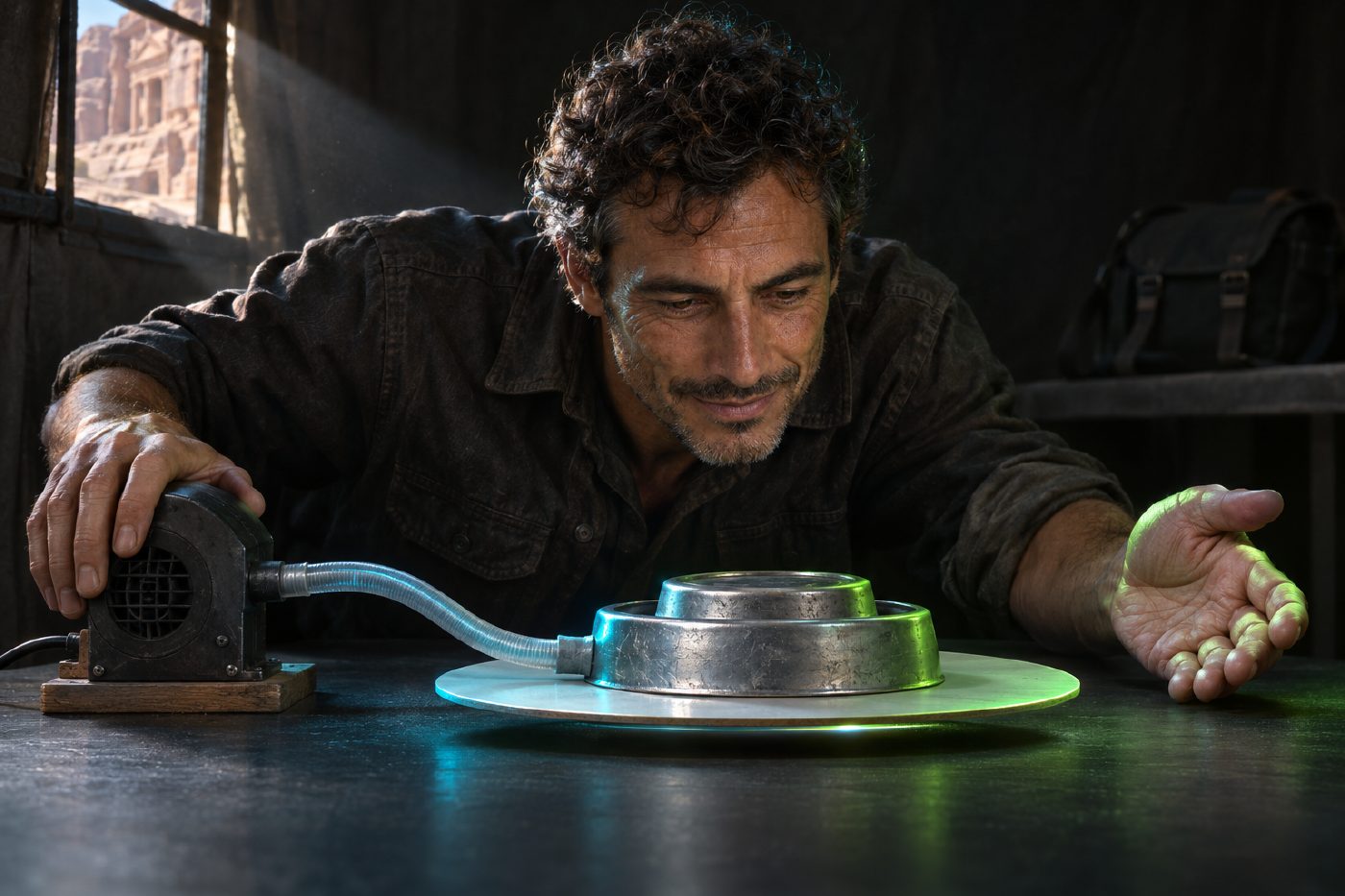
Morning, and Jack has given a corner of the Petra field-room table to two tins and a small blower. He nests one tin inside the other, leaving a narrow ring of space, and feeds air into the gap. Holding his palm below the open rims, he feels the push. An invisible thing, making a very definite objection.
He fits the tins to a light circular model over a smooth board. The blower hums. A thin shadow opens beneath the model; it lifts a few millimeters and trembles. Jack lowers his eyes to table level to check that it really has cleared the surface. His free hand catches the cool air escaping at the edge.
This is the principle Christopher Cockerell explored with nested tins: a ring of moving air helps contain a cushion at higher pressure beneath the craft. That pressure, acting over its underside, supports the load. Air must keep coming because it keeps leaking out. No wings, no grand ascent—just enough separation to stop resting on the surface.
Cockerell's work led to the SR.N1, which crossed the English Channel in 1959. Jack's little model crosses nothing this morning. He switches off the blower and watches it settle, then switches it on again. The tiny gap is worth a second look.